
Part I
Biography
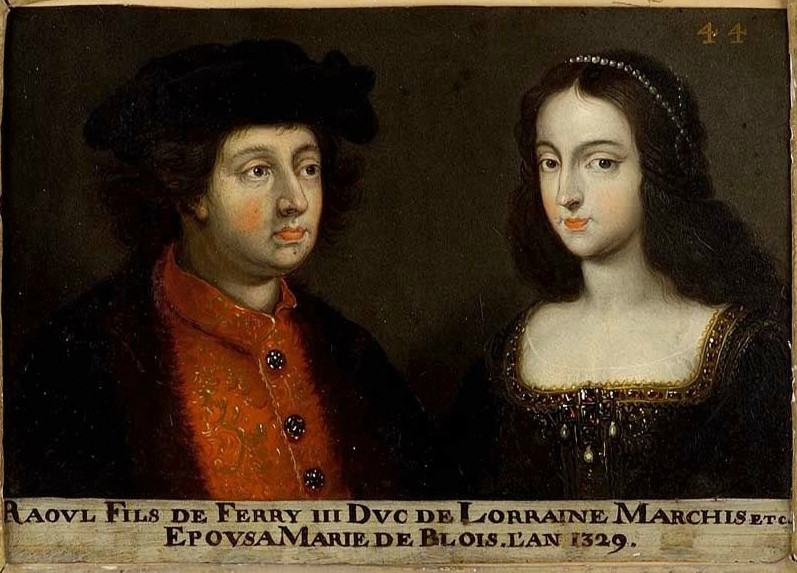

Raoul was a child of nine when he succeeded his father, Ferry IV, in 1329. Because he was still a minor, the government of the duchy passed to his mother, Elisabeth of Austria (known in Lorraine as Isabelle), who served as regent until he was declared of age in 1334. In 1329 Raoul married Eleanor of Bar, daughter of Edward I, Count of Bar. Eleanor died in 1332, and this marriage produced no children.
In 1334 Raoul married Marie de Châtillon, daughter of Guy I de Châtillon, Count of Blois and Dunois, and Margaret of Valois, sister of King Philip VI of France. Marie was therefore the French king’s niece. The marriage also gave the ducal house interests in the Picard lordships of Boves and Guise, although these remained separate French fiefs and were not incorporated territorially into the Duchy of Lorraine. This marriage to the French king’s niece further strengthened the ties between the Duke of Lorraine and the French Crown — ties that had already been significantly reinforced during his father’s reign.
Relations between the dukes of Lorraine and the counts of Bar were marked by recurrent feudal and territorial disputes. In 1337, Henry IV of Bar refused to render homage to Raoul for certain lands which, although incorporated into the Barrois domain, were held feudally from the Duke of Lorraine. Raoul responded by attacking lands dependent upon the Barrois castellany of Pont-à-Mousson. Henry retaliated, and the conflict developed into a series of reciprocal raids and acts of devastation across the duchy of Lorraine and the Barrois. An exceptionally detailed medieval record documents the effects of this conflict: a parchment roll, written in the Lorraine vernacular, containing a village-by-village account of the losses claimed by Raoul’s subjects. François Bonnardot analysed and published the document in 1872.1
Raoul’s reign also coincided with the opening phase of the Hundred Years’ War. When Charles IV of France died in 1328 without a surviving son, the French magnates recognised his cousin Philip of Valois as King Philip VI. Edward III of England, Charles’s nephew through his mother, Isabella of France, subsequently advanced a rival claim to the French throne. The succession question was only one element in a broader conflict that also involved English possessions in France, feudal sovereignty over Aquitaine, and French and English intervention in Scotland and Flanders. Open war began in 1337, after Philip VI declared Edward’s duchy of Aquitaine forfeited.
On 24 June 1340, the English fleet decisively defeated the French at Sluys. Edward then joined his continental allies in the siege of Tournai, while Raoul, Henry IV of Bar, and the bishops of Metz and Verdun supported Philip VI. The campaign ended with the Truce of Espléchin, concluded on 25 September 1340 and intended to last until the following June. During this suspension of hostilities, Raoul reportedly travelled to the Iberian Peninsula to join Alfonso XI of Castile in his campaign against the Marinids and the Emirate of Granada. Later Lorraine accounts associate him with the Castilian victory at the Río Salado, near Tarifa, on 30 October 1340.2 The chronology is tight, however: Raoul would have had barely five weeks to travel from the Tournai front to Andalusia, and his participation is best treated as a tradition rather than an established fact.
It would nonetheless be misleading to portray Raoul as concerned exclusively with warfare. On 27 May 1339 he founded the collegiate church of Saint-Georges in Nancy, built against the ducal residence and served by a chapter of twenty canons.3 According to the chapter’s own later tradition, the foundation was encouraged by his mother, Elisabeth, who had inherited a relic of Saint George from her father, Albert I of Habsburg. Saint-Georges soon became the principal church of the ducal court and a dynastic burial place.
He also promoted the fairs of Nancy and regulated commercial activity within the duchy. On 23 January 1341, he confirmed the establishment of a confraternity in honour of Saint George by the merciers of Nancy, Saint-Nicolas-de-Port, Rosières, and elsewhere in Lorraine, particularly those attending the fairs of Nancy. The head of the confraternity, styled the “King of the Merciers” and invested with the staff of Saint George, exercised authority over all merciers operating in the duchy, whether or not they belonged to the confraternity. With the assistance of four elected representatives from Nancy and Saint-Nicolas-de-Port, he could discipline offending merchants, prohibit others from trading with them until restitution had been made, and seize false weights, fraudulent balances, and adulterated merchandise. The charter also required the confraternity to make an annual offering to Raoul’s own foundation of Saint-Georges during the May fair at Nancy. This measure illustrates Raoul’s role not merely as a military leader but as an administrator who brought ducal authority, religious patronage, mercantile discipline, and the promotion of Nancy’s fairs into a single institutional framework.4
Raoul subsequently supported his brother-in-law Charles de Blois in the War of the Breton Succession. Charles claimed the duchy through his wife, Jeanne de Penthièvre, while Edward III supported the rival claimant, John de Montfort. Raoul’s participation thus placed him once again within the wider Anglo-French conflict.
In July 1346, Edward III landed in Normandy and began the campaign that carried his army through Normandy and into Picardy. Raoul again joined Philip VI’s army. He was killed at the Battle of Crécy on 26 August 1346, together with King John of Bohemia, the counts of Vaudémont and Salm, and Raoul’s brother-in-law Louis, Count of Blois. Raoul left an infant son, Jean, born some six months before the battle. During Jean’s minority, the duchy was governed by his mother, Marie de Châtillon, as regent, together with Eberhard II, Count of Württemberg.
Notes
-
François Bonnardot, “Document en patois lorrain relatif à la guerre entre le comte de Bar et le duc de Lorraine (1337–8),” Romania 1, no. 3 (1872): 328–351, esp. 329–330, https://doi.org/10.3406/roma.1872.6587. ↩
-
H. Bogdan, La Lorraine des ducs, Tempus 515 (Paris: Perrin, 2013), Kindle edition, ch. “[chapter title]”; first published as La Lorraine des ducs: sept siècles d’histoire (Paris: Perrin, 2005).
↩ -
Foundation charter of Raoul, Duke of Lorraine, 1339, Archives départementales de Meurthe-et-Moselle, G 342; Henri Lepage, “L’insigne église collégiale Saint-Georges de Nancy,” Bulletin de la Société d’archéologie lorraine (1849): 157–283, esp. 159–160; Jean-Pierre Brelaud, “Fiche de la collégiale Saint-Georges de Nancy,” Collégiales — Base des collégiales séculières de France (816–1563), http://vafl-s-applirecherche.unilim.fr/collegiales/?i=fiche&j=50.
↩ -
Archives départementales de Meurthe-et-Moselle, G 355, no. 1, charter of Raoul, Duke of Lorraine, 23 January 1341; Laura Gili-Thébaudeau, ed., “transscript-470,” Telma — Chartes, TRANSSCRIPT, IRHT-CNRS, accessed 19 September 2026, https://telma-chartes.irht.cnrs.fr/21253.
↩
Part II
Coinage
De Saulcy judged the coins of Raoul to be generally scarce but free of any difficulty of classification, and on the whole the evidence bears him out. He catalogued twelve types, with two further varieties, and rejected one piece that an earlier collector had given to the duke. Every type he retained names Raoul, either by the initial R or in full as RADVLPHVS, and eight of the twelve name Nancy as the mint. Of the remaining four, one names the duchy instead and three name no place at all.
The coinage continues directly from that of Raoul’s father, Ferry IV. The sword of Nancy remains the principal reverse type. The sword between two shields each surmounted by a trefoil, the sword flanked by two birds, and the vertical band of three alerions all appear on Ferry IV’s coinage before they appear on Raoul’s. What Raoul’s coinage lacks is equally clear: there are no horsemen, no standing duke, and none of the French or English imitations that make Ferry IV’s coinage so varied.
Attribution at a glance
The types attributed to Raoul are more uniform than his father’s, but they do not all rest on equally strong evidence. The summary below groups them by legend and design before they are described in detail.
| Group | Type | Present assessment | Principal evidence |
|---|---|---|---|
| Initial-R Nancy group | Shield of Lorraine / sword, R. DVX LOTORENGIESaulcy V, 1–3 | Traditional | MONETA DE NANCEI; reverses continued from Ferry IV |
| Bridge type | Shield of Lorraine in a polylobed contour / sword between two shieldsSaulcy V, 5 | Strong | Obverse of the initial-R group, legend of the full-name group |
| Full-name Nancy group | Sword, shield-on-sword and cross types, RADVLPHVS DVXSaulcy V, 6, 8, 9, 12 | Strong | Full name and title; NANCEI |
| MARCHIO group | Cross fleuronnée and band-of-alerions typesSaulcy V, 4, 10, 11 | Strong | Full name and title; no mint named |
| Light denier | Band of alerions / cross, R. DVXSaulcy V, 7 | Provisional | Initial only; no mint; one specimen |
| Horseman denier | Horseman galloping left, cited by d’Elvange | Reassigned: Ferry IV | De Saulcy’s rereading of the initial as F |
The entries below retain de Saulcy’s plate numbering as a citation. His weights were expressed in Paris grains, calculated at 54 mg to the grain. Gram values are therefore conversions of his figures, not independent modern measurements. De Saulcy does not name the denominations, and none is assigned here; where weight suggests a distinction between heavier and lighter pieces, the text says so without converting it into a name.
The initial-R group
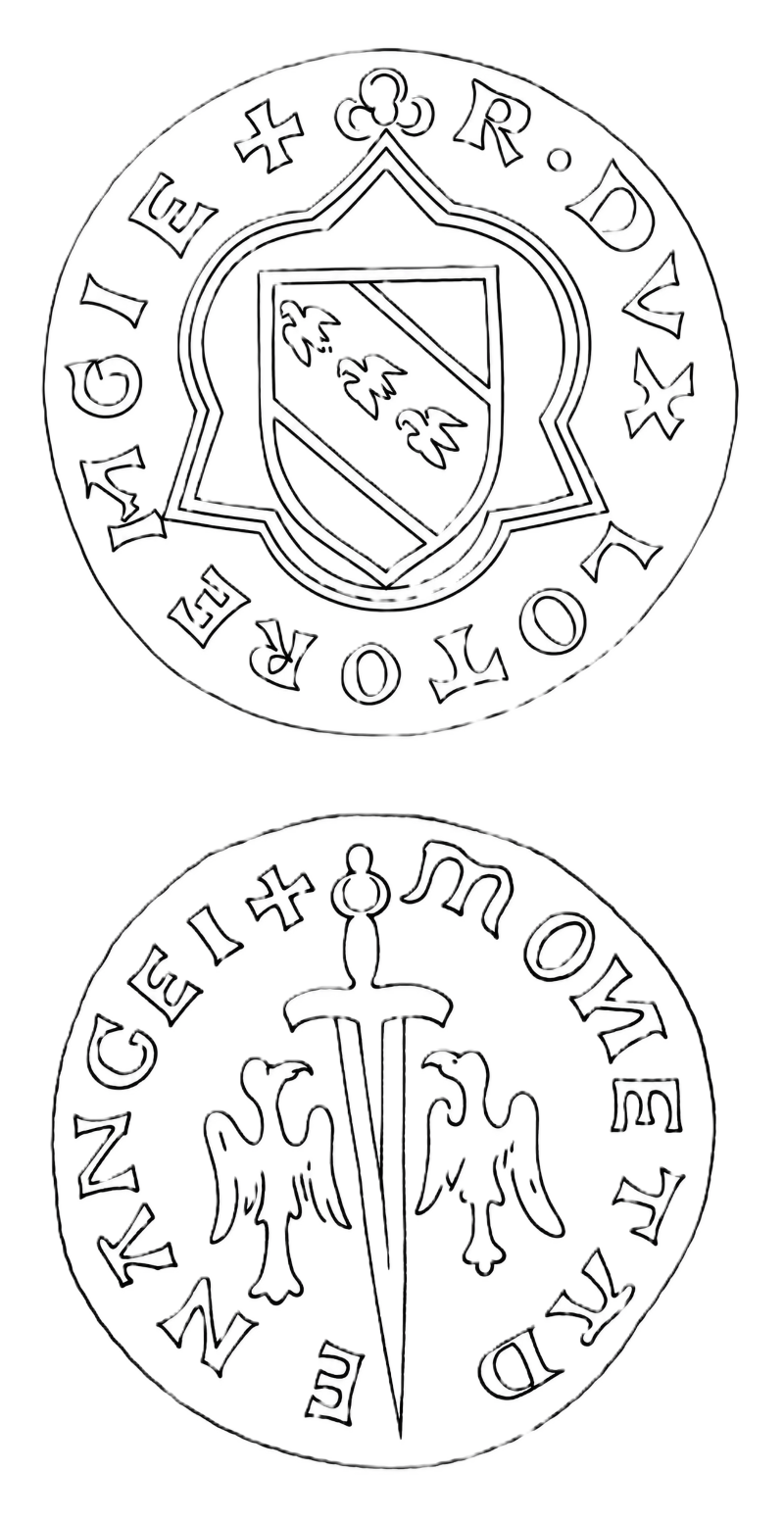
Three types name the duke by the initial R alone and set the shield of Lorraine in a curvilinear cartouche, with the mint named as NANCEI on the reverse. They differ in the reverse design and, sharply, in weight.
The first reads + R. DVX LOTORENGIE, and its reverse, + MONETA DE NANCEI, shows a sword point downward flanked by two eagles. De Saulcy knew the coin through d’Elvange, from the collection of M. Constantin, goldsmith at Pont-à-Mousson, at 18 grains, or 0.972 g (Pl. V, 1). The design continues the reverse of Ferry IV’s horseman double denier, on which the sword stands between two alerions.
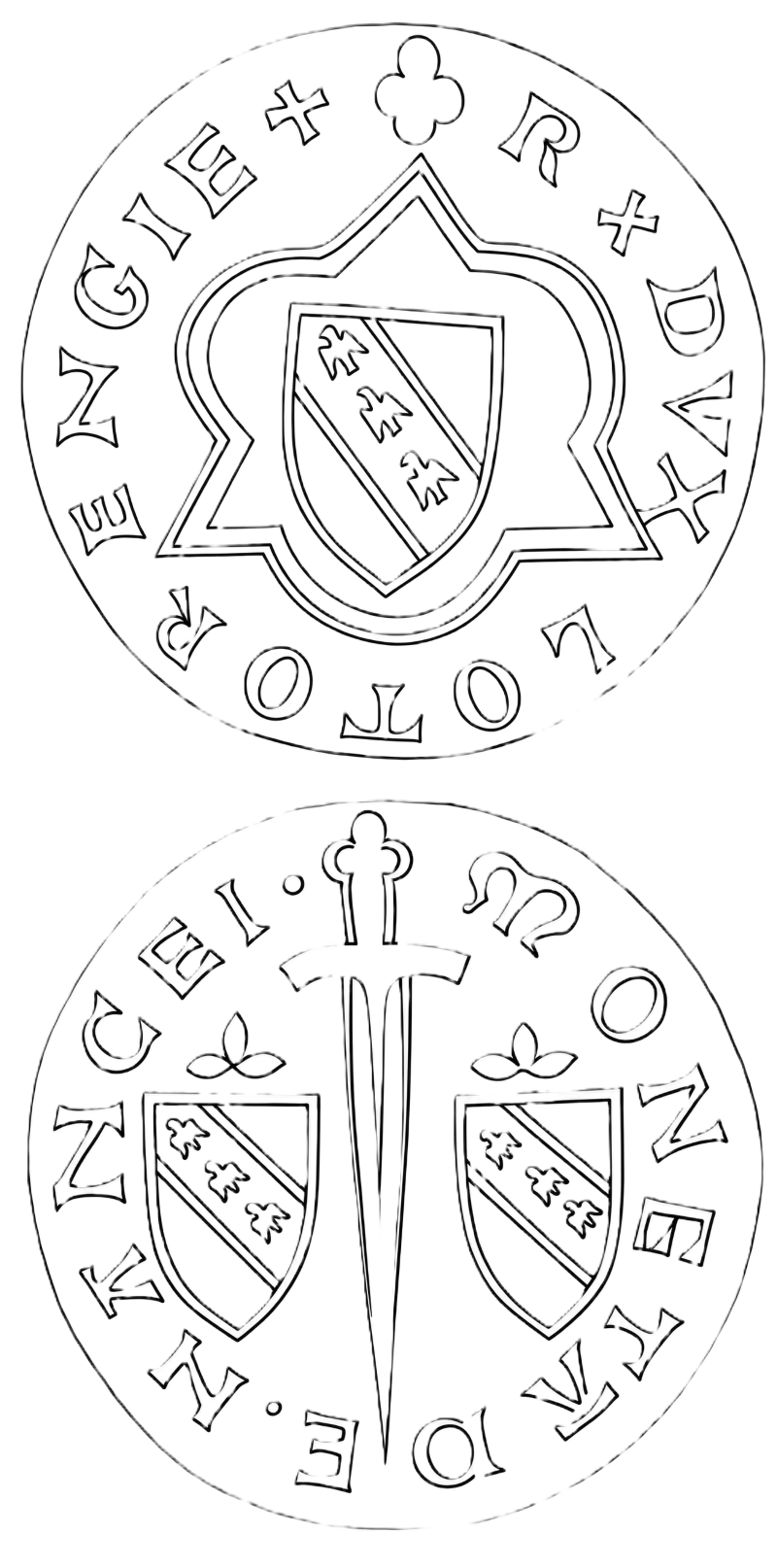
The second reverse replaces the birds with two shields of Lorraine, each surmounted by a trefoil. The same design occurs on two coins of very different weight. The piece recorded by d’Elvange from the collection of Dom Brulant, a Benedictine of Flavigny, reads + R × DVX LOTORINGIE and weighed 42 grains, or 2.268 g (Pl. V, 2); de Saulcy’s own specimen, + R DVX : LOTORENGIE with MONETA : DE : NANCEI, weighed 16 grains, or 0.864 g (Pl. V, 3). A heavier and a lighter coin of one design suggests two denominations struck to a single pattern. That inference rests on one specimen of each, however, and the heavier is known only through d’Elvange’s record.
This reverse, too, is inherited. The sword between two trefoiled shields is the reverse of the shield-and-trefoil double denier that de Saulcy placed under Ferry IV (Pl. IV, 1).
The shield in a polylobed contour
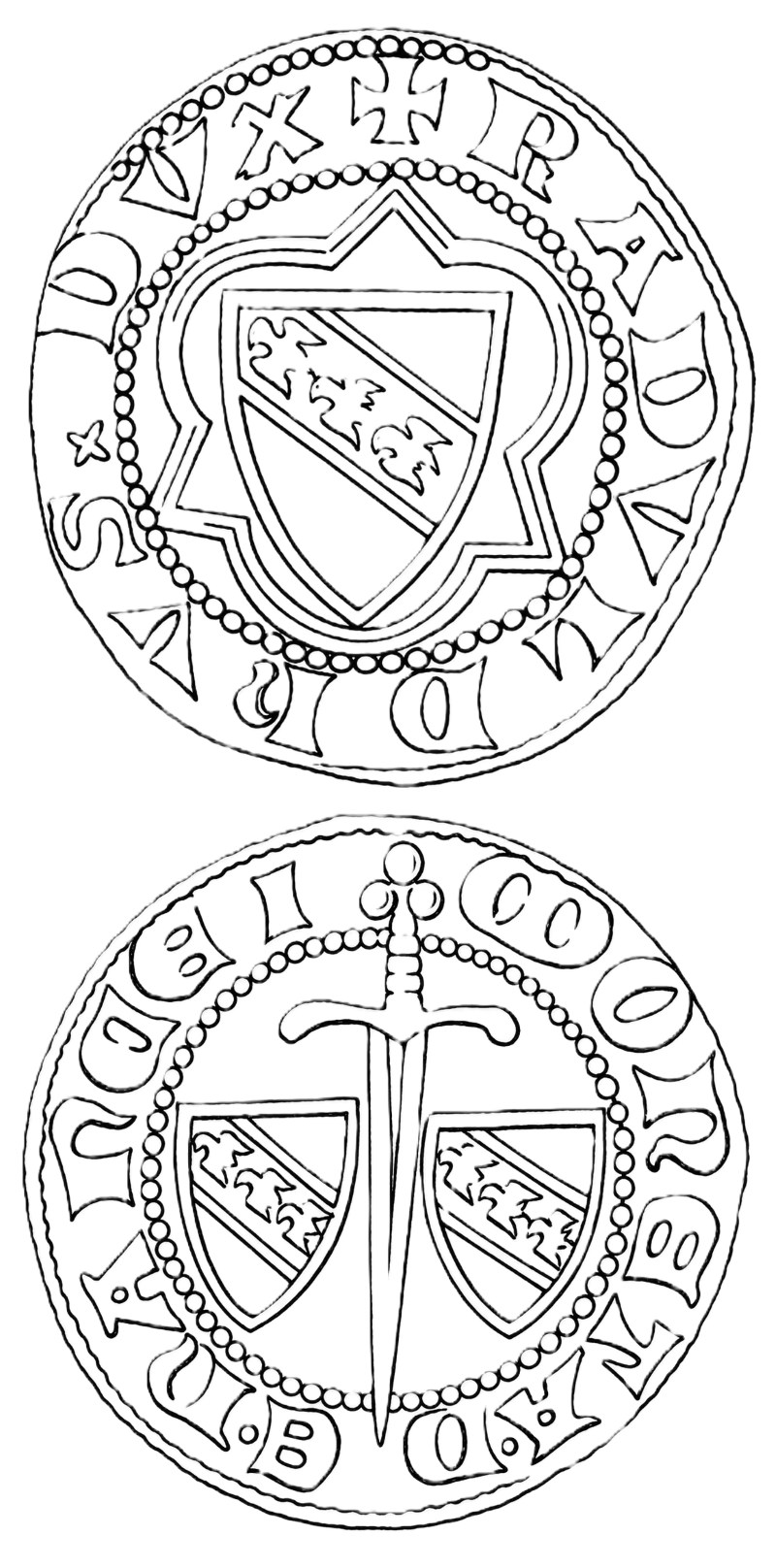
One type stands between the two halves of the coinage. Its obverse keeps the shield of Lorraine of the initial-R group, set here in a contour of arcs meeting in points within a beaded circle, but its legend, + RADVLPHVS ⁚ DVX, names the duke in full as the later types do. The reverse, MONETA . DE . NANCEI, shows a sword between two shields of Lorraine, this time without trefoils, its blade crossing a beaded inner circle. De Saulcy’s own specimen weighed 18 grains, or 0.972 g (Pl. V, 5).
On the plate the name is drawn with a D where the printed text has a P, giving RADVLDhVS. Whether that reproduces an engraver’s error on the coin or is the draughtsman’s own slip cannot be settled from a drawing.
The full-name Nancy group
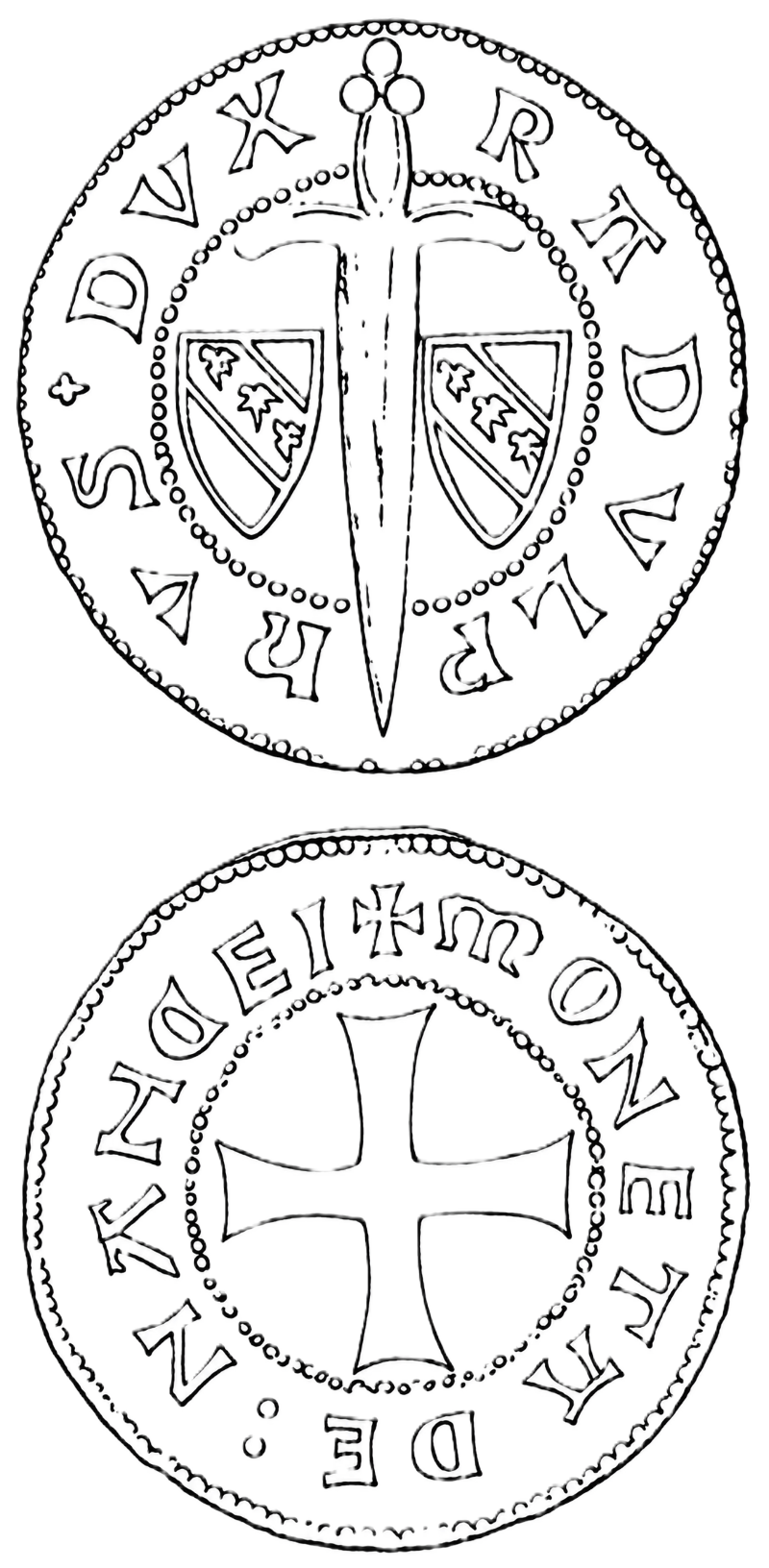
Four types name the duke in full, almost always with the title, and the mint as NANCEI. Their designs are built from three elements: the sword, the shield of Lorraine and a plain cross.
On the first, RADVLPHVS ⁚ DVX surrounds a sword between two shields of Lorraine; the reverse, + MONETA . DE . NANCEI, shows a cross pattée within a beaded circle. The specimen recorded by d’Elvange from the cabinet of M. Recouvreur, attorney at Nancy, weighed 18 grains, or 0.972 g, and de Saulcy describes it as silver of very low fineness (Pl. V, 6). D’Elvange also recorded a smaller piece of the same types in pure silver, weighing 10 grains, or 0.540 g, from the collection of M. Platel the younger, goldsmith at Nancy. The two are the only coins of Raoul whose metal de Saulcy describes, and they differ in metal as well as size.
A light piece reads RADVLPH around the shield of Lorraine, set here in a quadrilateral cartouche rather than the curvilinear one of the other types. The reverse reads MONETA NANCEI around a sword. De Saulcy gives its weight as the same as that of fig. 7, 10 grains weak, or 0.539 g; the coin was in the cabinet of M. Motte, notary at Sarrelouis (Pl. V, 8*). This is the only type in the corpus to give the name without the title.
The two remaining types introduce a new design: the shield of Lorraine laid directly on the blade of the sword. On one, RADVLPHVS ⁚ DVX surrounds this device and the reverse reads + MONETA : DE : NANCEI around a cross; d’Elvange recorded it from the collection of M. de Mesang, an officer in the Austrian service, at 20 grains weak, or 1.079 g (Pl. V, 9). On the other, RADVLPHVS DVX, the same obverse is paired with the sword between two shields of Lorraine and MONETA DE NANCEI. D’Elvange recorded it from the collection of M. Charroyer, curé of Gircourt, at 14 grains, or 0.758 g (Pl. V, 12).
The MARCHIO group
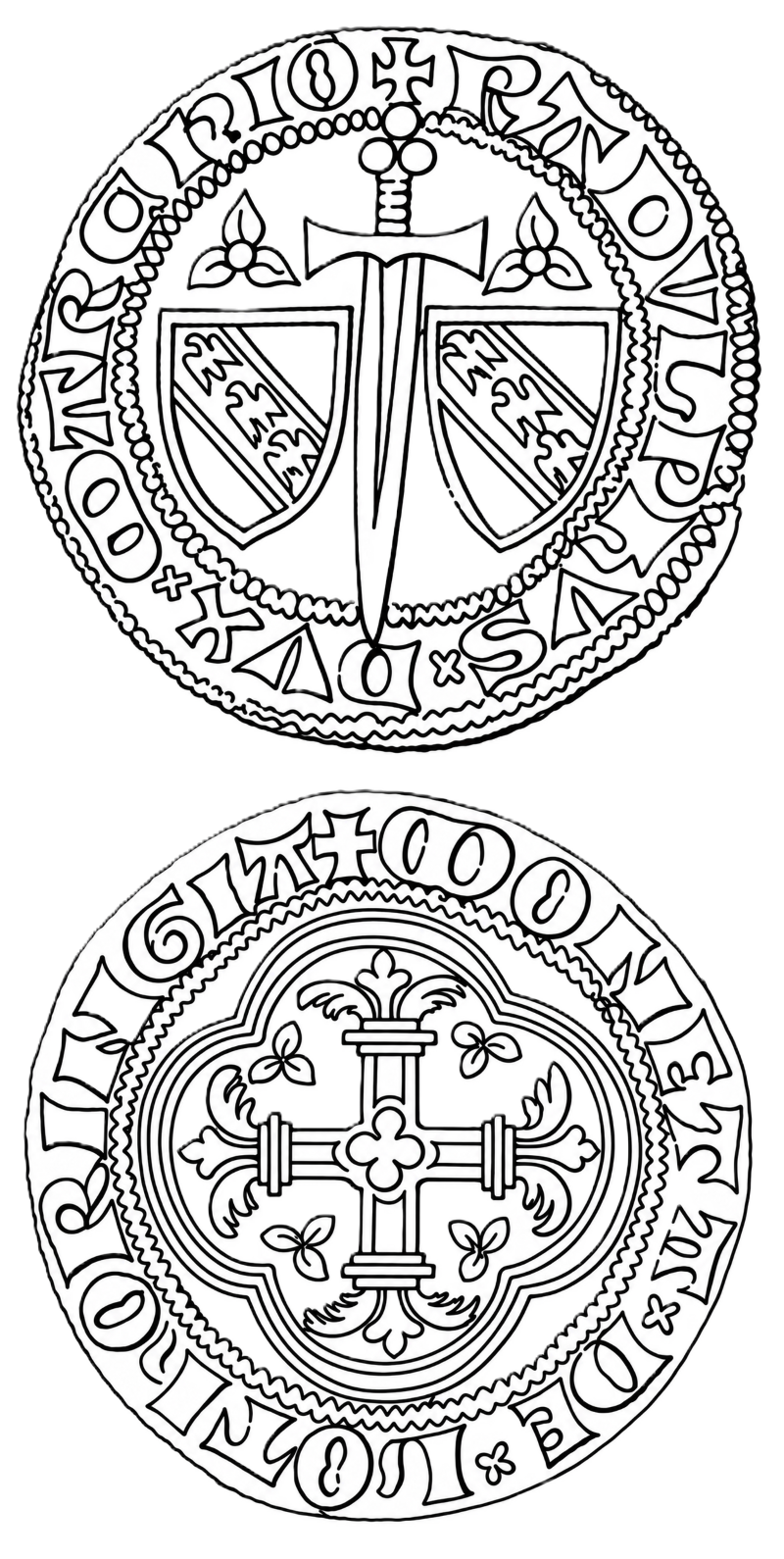
Three types add the title MARCHIO, written in full on figs 4 and 11 and abbreviated to MARCHI on fig. 10. Dux et marchio — duc et marchis in the vernacular — was the standing style of the dukes of Lorraine, not a separate territorial claim. None of these three coins names a mint. Their attribution to Nancy rests on design alone, and the designs do link them closely to the Nancy issues.
The heaviest reads RADVLPHVS × DVX × MARCHIO, the fullest style in the corpus. Its obverse is the sword between two trefoiled shields, the design that forms the reverse of figs 2–3. The reverse, + MONETA × DE × LOTORINGIA, shows a cross fleuronnée with a quatrefoil at its centre, cantoned with four trefoils and enclosed in a cartouche of four arcs. The specimen, from the cabinet of M. Voillemier, weighed 36 grains, or 1.944 g (Pl. V, 4). D’Elvange cited a variety on which the cross opening the reverse legend stands between two stars, at 42 grains, or 2.268 g — the weight of fig. 2. This is the only type in the corpus to name the duchy in place of the mint.
Two lighter types read + RADVLPHVS : MARCHI and + RADVLPHVS MARCHIO around a vertical band charged with three alerions, enclosed in a contour of four abutted arcs bearing pearls at the angles. Both reverses read DVX LOTORINGIE, so that the full style runs from one face to the other. The first reverse shows the sword between two eagles, as on fig. 1; de Saulcy’s own specimen weighed 17½ grains, or 0.945 g (Pl. V, 10). The second shows the shield laid on the sword, as on figs 9 and 12; d’Elvange recorded it from the collection of a goldsmith at Épinal, at 14 grains, or 0.758 g (Pl. V, 11).
The vertical band of three alerions is itself an inheritance. It is the diagnostic feature of Ferry IV’s standing-duke coinage, where it stands beside the duke. On Raoul’s coins, without the figure, it becomes the principal type.
The light denier with the band of alerions
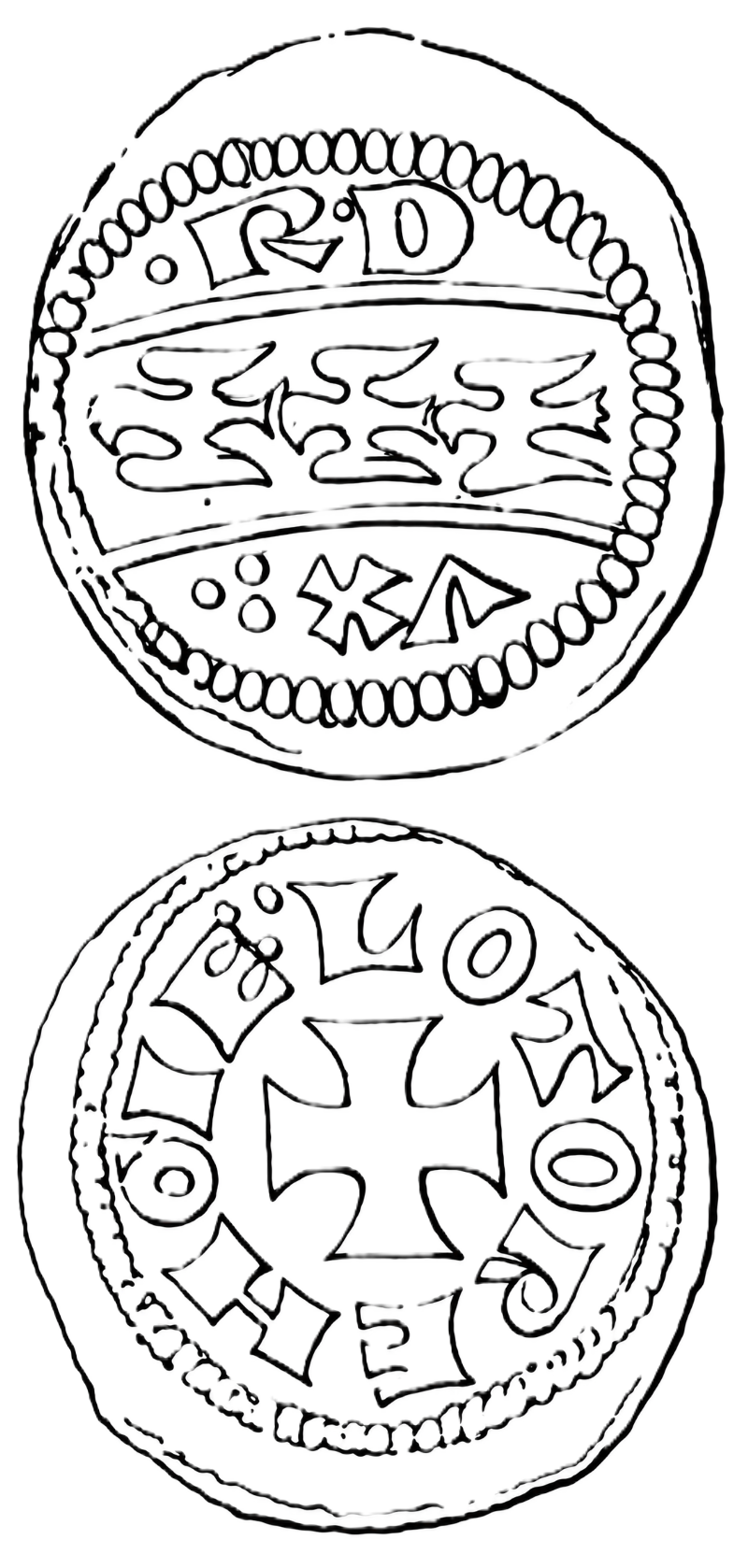
The lightest type reads · R · DVX ·.· across a band of three alerions, with LOTORINGIE ·.· around a cross on the reverse. The drawing shows how the obverse legend is set: the band runs horizontally across the field, within a beaded border, and the letters are written in the field above and below it rather than around the rim. The coin weighed 10 grains weak, or 0.539 g, and belonged to the cabinet of the city of Metz (Pl. V, 7*). Like fig. 8, it is marked with an asterisk on the plate.
This is the least secure attribution in the group. The coin carries only an initial, names no mint and is known from a single specimen. Its legend, however, is that of the initial-R group — the initial R, the title DVX and the territorial name — divided here between the two faces of a much smaller coin. Nothing in it points to another ruler, but it would benefit more than any other type here from the examination of a surviving specimen.
The horseman denier set aside
D’Elvange also recorded a denier with a horseman galloping to the left, which he read with the initial R and gave to Raoul. De Saulcy rejected the attribution. The coin matched in every respect the horseman deniers he had already described under Ferry IV, and he concluded that the initial was an F, for Ferricus, and that the type was in any case older than Raoul’s reign. The coin belongs with the galloping-left denier on the Ferry IV page (Pl. III, 21).
The correction matters beyond this one coin. Half of the types attributed to Raoul are known to de Saulcy only through d’Elvange’s Recueil, and this case shows that d’Elvange could misread the single letter on which an attribution depended.
How the types connect
The twelve types share their designs to an unusual degree. Several motifs pass from one face to the other between types:
- The sword between two trefoiled shields is the reverse of figs 2–3 and the obverse of fig. 4.
- The shield laid on the sword is the obverse of figs 9 and 12 and the reverse of fig. 11.
- The sword between two eagles is the reverse of both fig. 1 and fig. 10.
- The contour of four arcs frames the reverse of fig. 4 and the obverse of figs 10–11.
These links tie the MARCHIO group to both the initial-R group and the full-name group, and fig. 5 joins the obverse type of the first to the legend of the second. The coinage reads as one series from one workshop, and that is the strongest argument for placing the three coins that name no mint at Nancy. The links are shared designs, not demonstrated die links; only surviving specimens could show whether any dies were in fact shared.
One division runs through the legends: the initial R against the full name. It is tempting to read it as two phases, with the initial-R pieces belonging to the regency of 1329–1334, but de Saulcy proposed no internal chronology and nothing in his evidence establishes one. The territorial spelling will not help: LOTORENGIE and LOTORINGIE alternate within the initial-R group itself, figs 1 and 3 giving the first and fig. 2 the second.
Metrology and method
De Saulcy’s conversions follow the Paris grain at 54 mg: 42 grains is 2.268 g, 36 grains 1.944 g, 18 grains 0.972 g, 16 grains 0.864 g, 10 grains 0.540 g and 17½ grains 0.945 g, while “10 grains weak” and “20 grains weak” give the slightly lower 0.539 and 1.079 g. Only the 14-grain pieces, figs 11 and 12, are inexact: 0.758 g against a calculated 0.756, which is rounding rather than error.
Leaving the varieties aside, the recorded weights fall into three bands: about 2 g (figs 2 and 4), 0.76–1.08 g (seven types), and about 0.539 g (figs 7 and 8). The bands suggest at least three denominations. Each weight, however, is that of a single coin, and the middle band is too broad to divide on present evidence.
The quality of the evidence is uneven. Of the twelve types, de Saulcy handled three in his own collection (figs 3, 5 and 10). Three more were in named cabinets (figs 4, 7 and 8). The remaining six are known through d’Elvange, whose record the horseman denier shows to be fallible. A secure account of Raoul’s coinage will require surviving specimens, with modern weights, diameters, metal analyses and provenances.
Assessment
Raoul’s coinage is compact, coherent and conservative. It is struck at Nancy, or at a workshop using Nancy’s designs, and it is built almost entirely from motifs inherited from Ferry IV: the sword, the shield of Lorraine and the band of alerions. Its innovations lie in recombining them. The shield is laid on the sword, the band of alerions becomes a type in its own right, and the full style dux et marchio is carried across both faces of the coin.
The contrast with Ferry IV is as instructive as the continuity. The imitations of French and English money that mark his father’s reign have no counterpart under Raoul, although Raoul’s own ties to the French Crown were, if anything, closer. On the surviving evidence his coinage spoke a single, ducal monetary language.