
This is the whole of Raoul's coinage as it was known in 1841. Saulcy thought the series presented no difficulty of classification, and the designs bear him out: the same motifs pass from obverse to reverse across the twelve types, so that the three coins naming no mint are tied by their designs to those that name Nancy.
Legends, weights and cabinets are Saulcy's, from the printed French of pages 63 and 64. The gram figures are conversions of his grain weights at 54 mg to the grain, not modern measurements. The two figures marked with an asterisk carry it on the plate; what Saulcy meant by it has still to be established.
Six of the twelve drawings have been read letter by letter, and all six agree with his descriptions. Where a figure has been read, the note beneath it records what the drawing adds: the letterforms, the ornament, and in one case a D standing where the text has a P. The coinage is discussed type by type on the Raoul page.
-
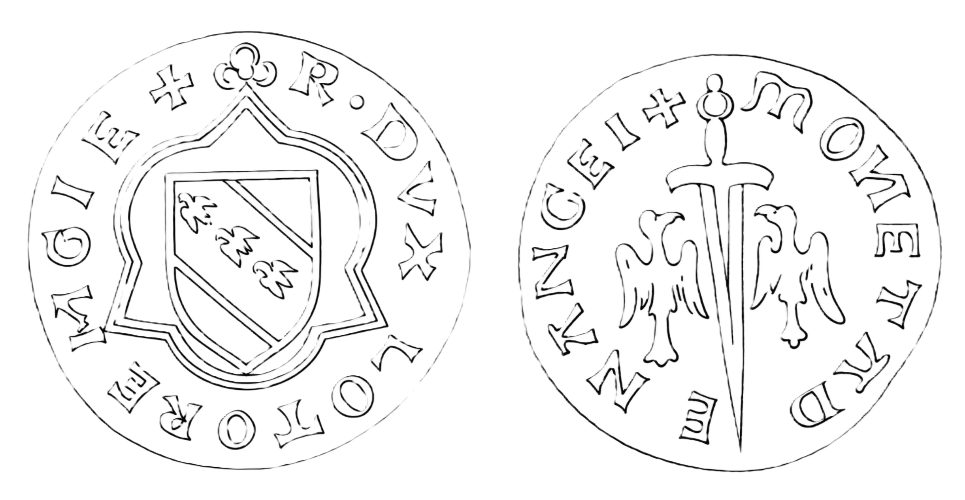
Fig. 1
Shield and sword between two eagles
- Obverse
- + R. DVX LOTORENGIE; shield of Lorraine in a curvilinear cartouche
- Reverse
- + MONETA DE NANCEI; sword point downward between two eagles
- Weight
- 18 grains, 0.972 g
- Specimen
- Cabinet Constantin, goldsmith at Pont-à-Mousson
- The drawing
- Agrees with the text. The trefoil at the top of the obverse is the finial of the cartouche breaking into the legend, not a stop. The birds have beaks and claws, so they are eagles rather than alerions.
Known through d’Elvange Drawing read in detail
-
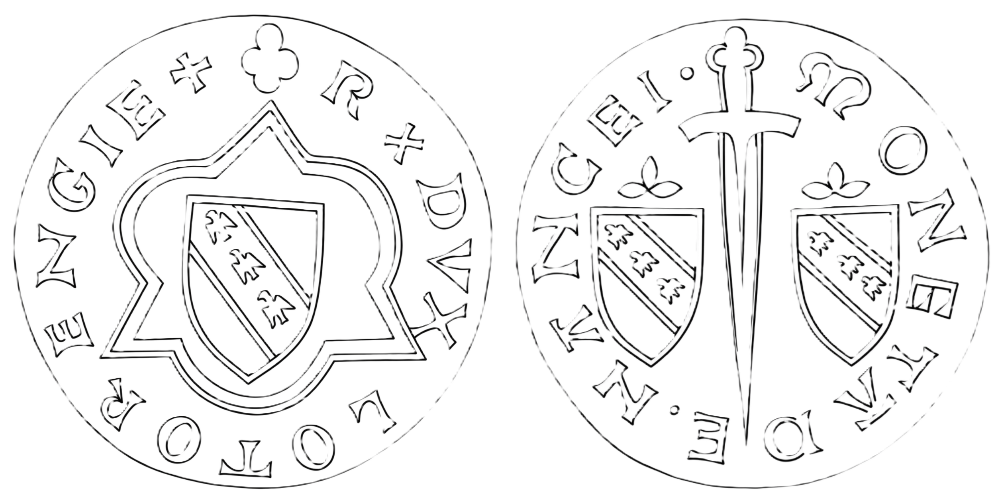
Fig. 2
Shield and sword between two trefoiled shields, heavy
- Obverse
- + R × DVX LOTORINGIE; shield of Lorraine in a curvilinear cartouche
- Reverse
- MONETA DE NANCEI; sword point downward between two shields of Lorraine, each surmounted by a trefoil
- Weight
- 42 grains, 2.268 g
- Specimen
- Cabinet of Dom Brulant, Benedictine of Flavigny
- The drawing
- Agrees with the text, including the saltire after R. A quatrefoil stands above the apex of the cartouche, at the head of the legend, and the reverse separators are drawn as pellets.
Known through d’Elvange Drawing read in detail
-
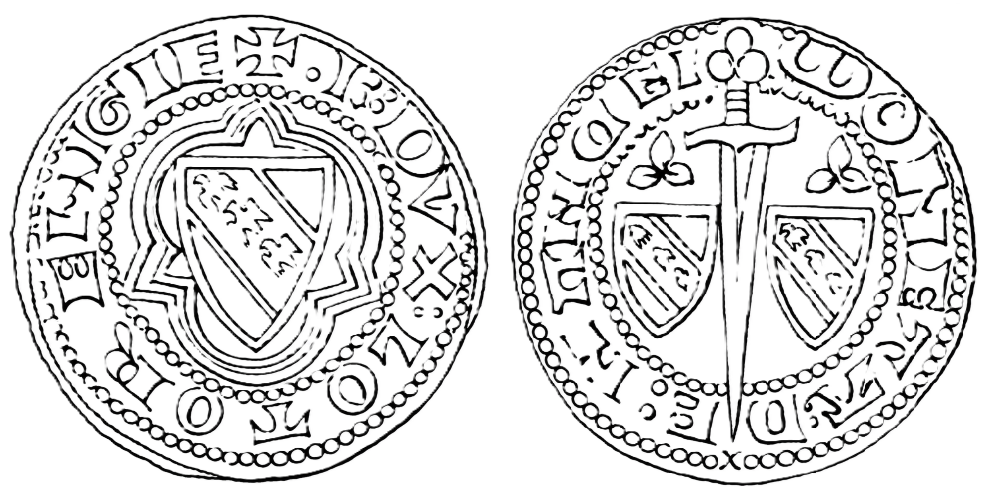
Fig. 3
The same design, light
- Obverse
- + R DVX : LOTORENGIE; shield of Lorraine in a curvilinear cartouche
- Reverse
- MONETA : DE : NANCEI; sword point downward between two trefoiled shields
- Weight
- 16 grains, 0.864 g
- Specimen
- Saulcy’s own collection
Saulcy’s own collection Drawing not yet read
-
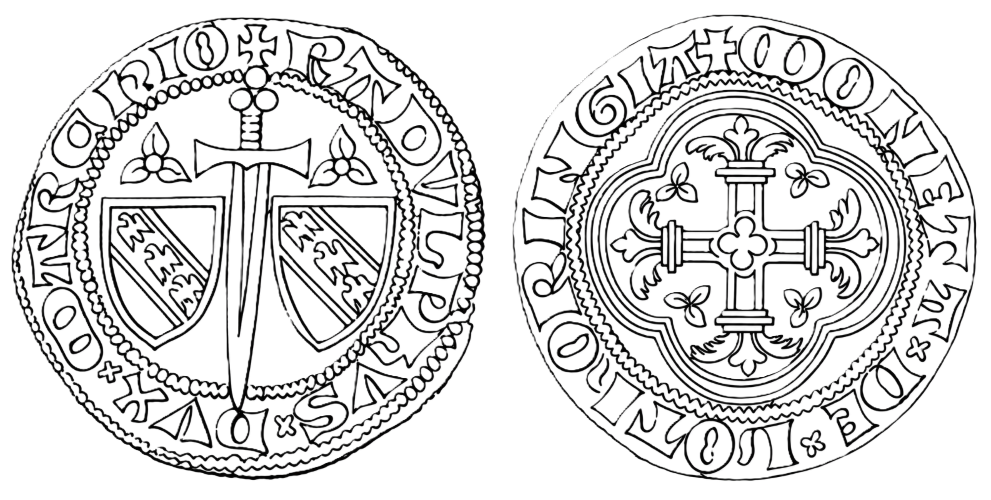
Fig. 4
Sword and cross fleuronnée
- Obverse
- RADVLPHVS × DVX × MARCHIO; sword point downward between two trefoiled shields
- Reverse
- + MONETA × DE × LOTORINGIA; cross fleuronnée cantoned with four trefoils, in a cartouche of four arcs
- Weight
- 36 grains, 1.944 g
- Specimen
- Cabinet Voillemier
- The drawing
- Agrees with the text. The name is drawn with an uncial h, RADVLPhVS; the cross has barred and foliated ends with a quatrefoil at its centre, and the whole sits within a cabled circle. D’Elvange recorded a variety with the initial cross of the reverse legend between two stars, at 42 grains, 2.268 g.
Seen in a named cabinet Drawing read in detail
-
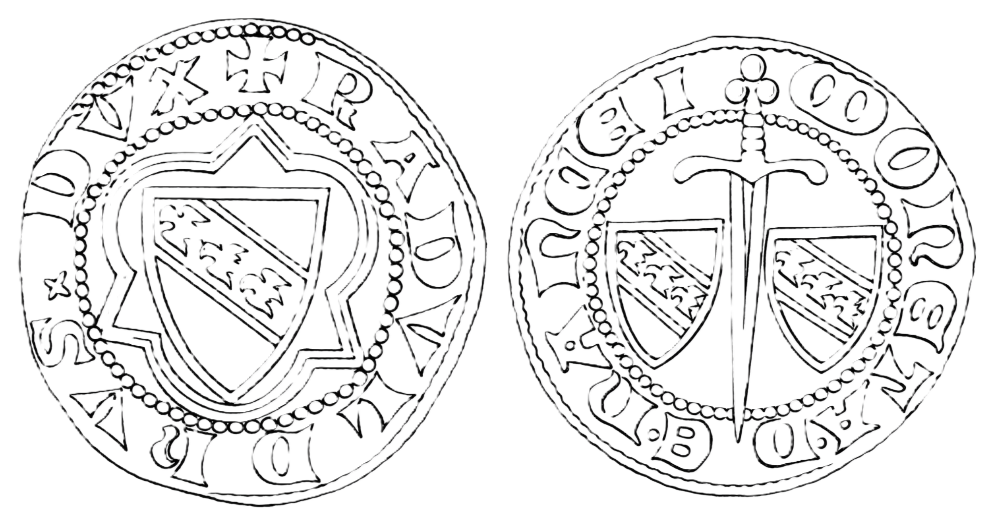
Fig. 5
Shield in a polylobed contour
- Obverse
- + RADVLPHVS ⁚ DVX; shield of Lorraine in a curvilinear contour
- Reverse
- MONETA . DE . NANCEI; sword point downward between two shields of Lorraine
- Weight
- 18 grains, 0.972 g
- Specimen
- Saulcy’s own collection
- The drawing
- The name is drawn RADVLDhVS, with a D where the text has a P, and the legend closes with a saltire after DVX. Whether the D stood on the coin or is the draughtsman’s slip cannot be told from a drawing. The sword’s blade crosses a beaded inner circle.
Saulcy’s own collection Drawing read in detail
-
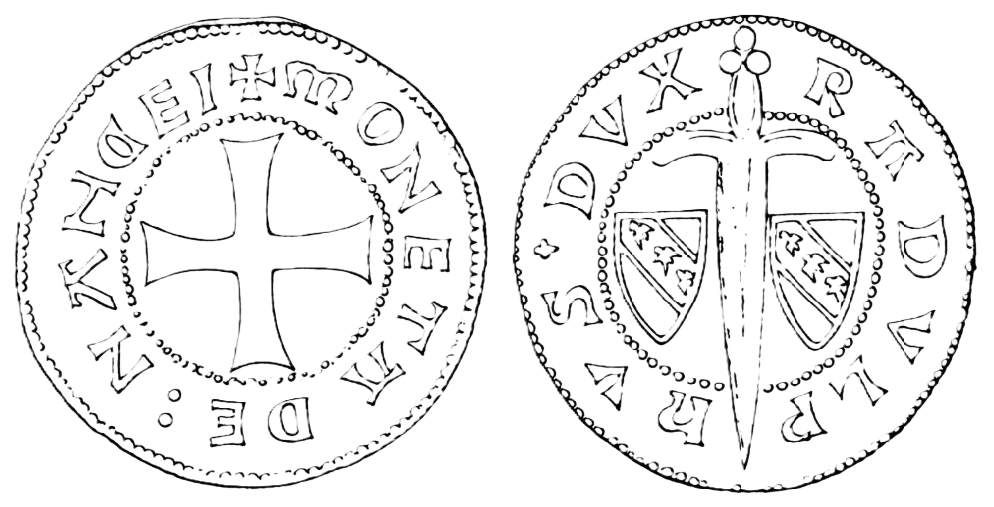
Fig. 6
Sword between two shields, with cross
- Obverse
- RADVLPHVS ⁚ DVX; sword point downward between two shields of Lorraine
- Reverse
- + MONETA . DE . NANCEI; cross. Silver of very low fineness
- Weight
- 18 grains, 0.972 g
- Specimen
- Cabinet Recouvreur, attorney at Nancy
- The drawing
- Agrees with the text, with the name drawn RADVLPhVS and a small cross where the text has the two-dot stop. The reverse cross is pattée, within a beaded circle. D’Elvange recorded a smaller piece of the same types in pure silver, at 10 grains, 0.540 g, from the collection of M. Platel the younger, goldsmith at Nancy.
Known through d’Elvange Drawing read in detail
-
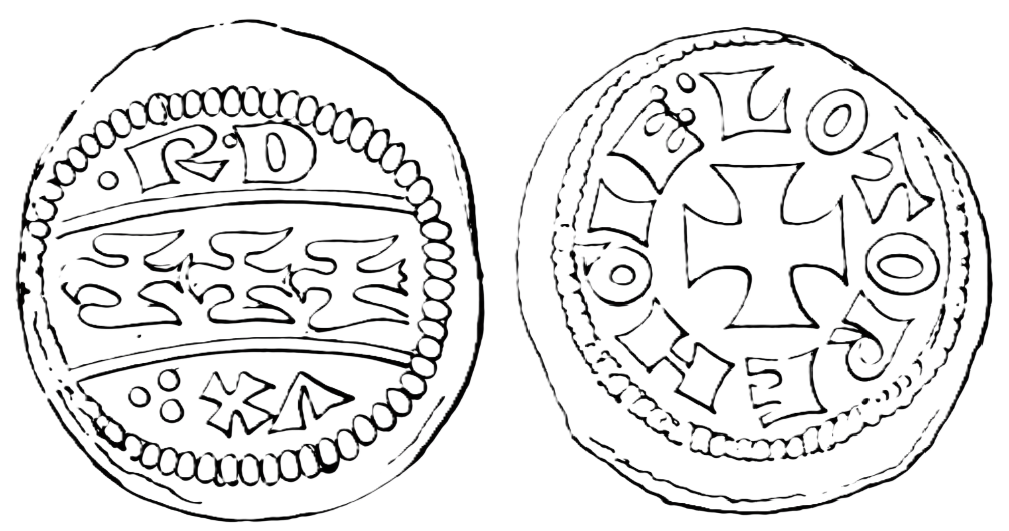
Fig. 7*
Band of alerions and cross
- Obverse
- · R · DVX ·.·; curvilinear band charged with the three alerions of Lorraine
- Reverse
- LOTORINGIE ·.·; cross
- Weight
- 10 grains weak, 0.539 g
- Specimen
- Cabinet of the city of Metz
- The drawing
- Agrees with the text, and shows how the obverse legend is set: the band runs horizontally across the field within a beaded border, and the letters are written in the field above and below it rather than around the rim. The reverse cross is pattée.
Seen in a named cabinet Drawing read in detail
-
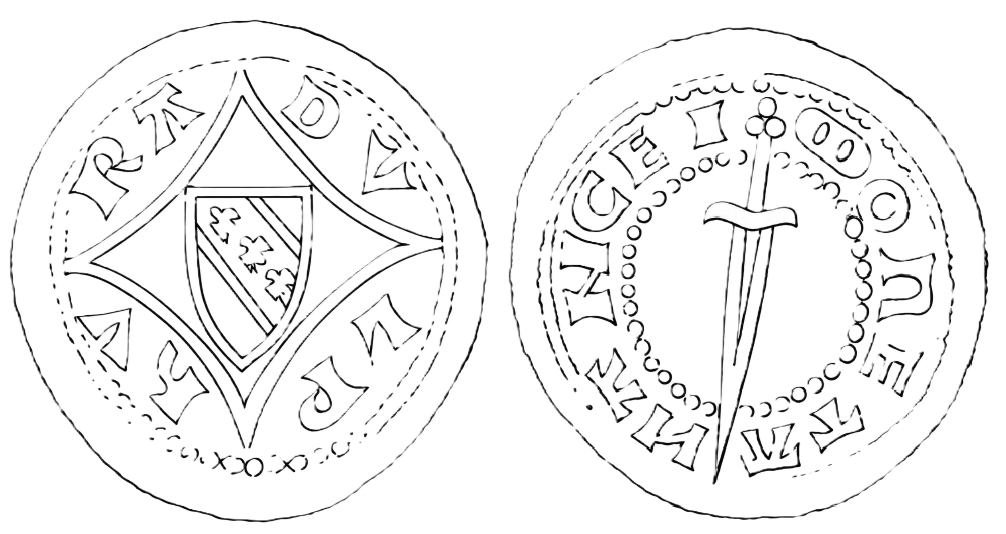
Fig. 8*
Shield in a quadrilateral cartouche
- Obverse
- RADVLPH; shield of Lorraine in a quadrilateral cartouche
- Reverse
- MONETA NANCEI; sword point downward
- Weight
- Same weight as fig. 7: 10 grains weak, 0.539 g
- Specimen
- Cabinet Motte, notary at Sarrelouis
Seen in a named cabinet Drawing not yet read
-
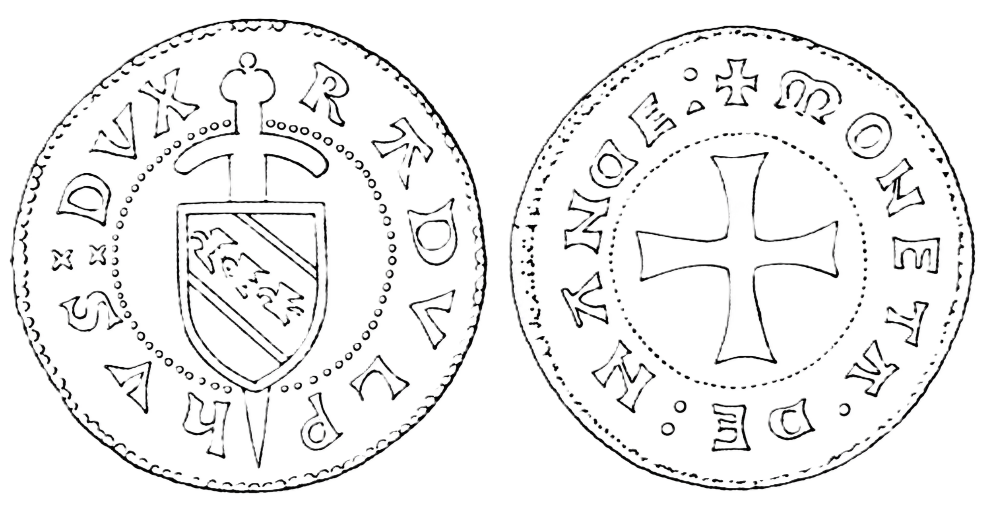
Fig. 9
Shield on the sword, with cross
- Obverse
- RADVLPHVS ⁚ DVX; sword point downward charged with the shield of Lorraine
- Reverse
- + MONETA : DE : NANCEI; cross
- Weight
- 20 grains weak, 1.079 g
- Specimen
- Collection of M. de Mesang, officer in the Austrian service
Known through d’Elvange Drawing not yet read
-
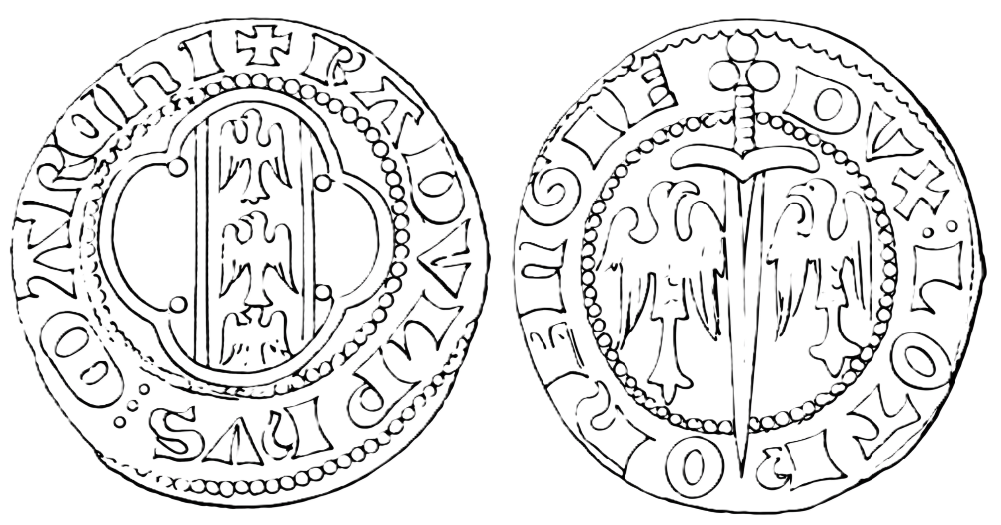
Fig. 10
Band of alerions and sword between two eagles
- Obverse
- + RADVLPHVS : MARCHI; vertical band charged with three alerions, in a contour of four arcs bearing pearls at the angles
- Reverse
- DVX : LOTORINGIE; sword point downward between two eagles
- Weight
- 17½ grains, 0.945 g
- Specimen
- Saulcy’s own collection
Saulcy’s own collection Drawing not yet read
-
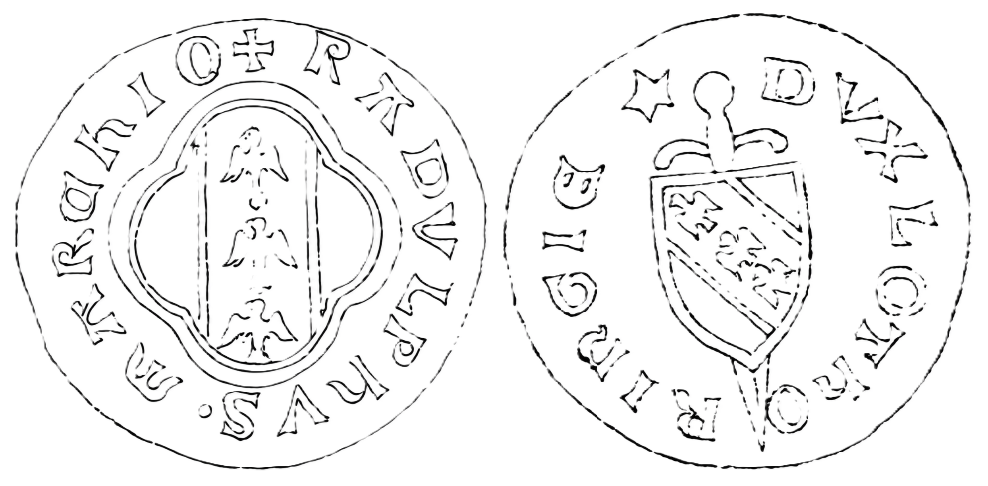
Fig. 11
Band of alerions and shield on the sword
- Obverse
- + RADVLPHVS MARCHIO; same obverse type as fig. 10
- Reverse
- DVX LOTORINGIE. ; shield of Lorraine laid on a sword point downward
- Weight
- 14 grains, 0.758 g
- Specimen
- Collection of a goldsmith of Épinal
Known through d’Elvange Drawing not yet read
-
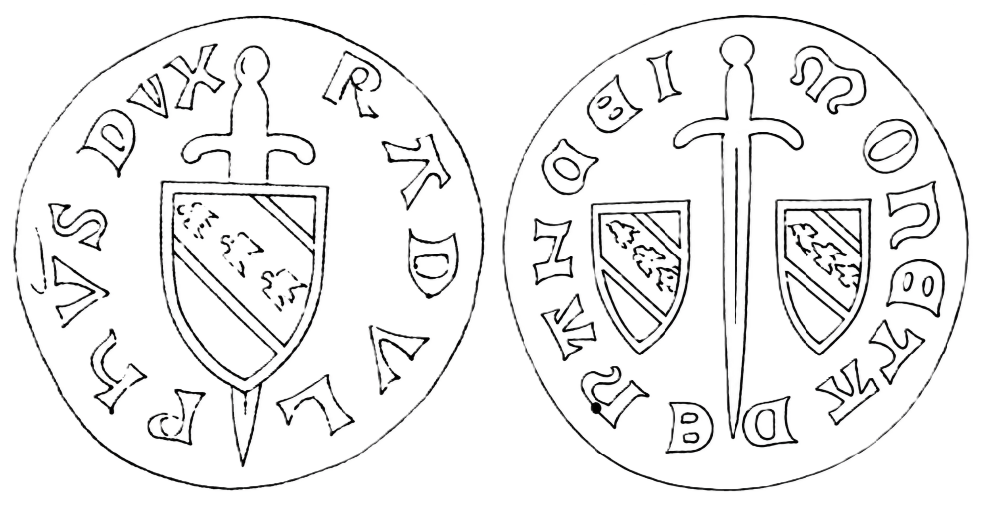
Fig. 12
Shield on the sword, with sword between two shields
- Obverse
- RADVLPHVS DVX; shield of Lorraine laid on a sword point downward
- Reverse
- MONETA DE NANCEI; sword point downward between two shields of Lorraine
- Weight
- 14 grains, 0.758 g
- Specimen
- Collection of M. Charroyer, curé of Gircourt
Known through d’Elvange Drawing not yet read
Read down the first label under each drawing and the weakness of the evidence is plain. Saulcy handled three of these coins himself and saw three more in named cabinets. The remaining six, half the corpus, he knew only through d'Elvange's eighteenth-century Recueil — the same source that gave him a horseman denier for Raoul which he rejected, having satisfied himself that its initial was an F and that the coin belonged to Ferry IV.
Nothing here can settle the weights, the fineness or the denominations, all of which rest on single specimens recorded before 1841. What the plate can settle is what the coins looked like and what their legends said, and on those points it has so far confirmed Saulcy's text at every turn.