
Biography
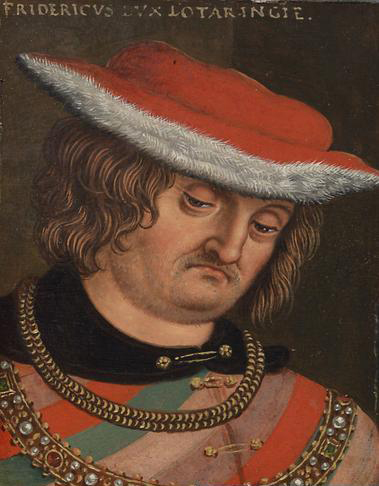

Ferry IV was born on 15 April 1282 at Gondreville. He was the eldest son of Duke Thibaut II and Isabella of Rumigny. Later tradition preserved for him the nickname le Lutteur — “the Fighter” — a name well suited to a prince whose life was spent largely at war. He fought in Lorraine, Germany, Guyenne, and Flanders, and military obligations repeatedly shaped the political direction of his reign.
According to later tradition, Ferry received his early education at the abbey of Bonnefontaine in the Ardennes, a monastery closely connected with his mother’s family. Whatever learning he acquired there, his training soon took on a far more military character. From an early age Ferry accompanied his father on campaign. He was probably among the Lorraine troops who fought on the French side at Courtrai in 1302 and at Mons-en-Pévèle in 1304. By the time he inherited the duchy he already possessed considerable experience of war and of princely politics.
In 1304 Ferry married Elisabeth of Austria, known in Lorraine as Isabelle. She was a daughter of Albert I of Habsburg, King of the Romans, and a sister of Frederick the Fair of Austria. The marriage bound Ferry to one of the most powerful dynasties of the Empire and later determined his position during the disputed imperial election of 1314.
Thibaut II died on 13 May 1312, having shortly before founded a collegiate chapter of Saint Nicholas at his castle of Darney. Ferry inherited the duchy and was soon drawn into the local conflicts characteristic of political life in the lands between the Meuse and the Rhine. Early in his reign he campaigned against the count of Dagsburg, whose lands bordered Lorraine territory in the region of Lorquin. That dispute ended in an agreement, but a far more serious conflict was already brewing in the neighbourhood of Metz.
Its origins went back to the reign of Thibaut II. In 1305 Thibaut was present at Lyon for the coronation of Pope Clement V, who charged him with collecting the crusading tithe from the Lorraine clergy. Renaud de Bar, bishop of Metz, opposed the levy. Ferry inherited the resulting confrontation on his father’s death.
In 1313 the dispute broke into open war. Renaud called on his kinsmen and allies, among them his nephew Edward I, count of Bar, whose guardian he had formerly been. On 8 November the opposing forces met near Frouard, north of Nancy. Ferry was victorious, and Edward was taken prisoner.
The count’s capture gave the duke a considerable advantage in negotiation. Edward’s release was made conditional on heavy financial and political concessions, remembered afterwards in the Barrois as exceptionally harsh. The exact length of his captivity is unknown: some sources speak of only a few months, others extend it considerably. In the end Louis, king of Navarre and the future Louis X of France, intervened in the negotiations. To meet at least part of the terms of his release, Edward was obliged to borrow a large sum.
That debt would later become one of the causes of a much larger war with the city of Metz.
On 24 August 1313 the Holy Roman Emperor Henry VII died in Italy. In October 1314 the electors split into two opposing camps. On 19 October one group, meeting at Sachsenhausen near Frankfurt, elected Frederick the Fair of Austria. The following day another group, sitting at Frankfurt, elected Louis of Bavaria. Both claimants were subsequently crowned, and each proclaimed himself King of the Romans.
Ferry could hardly remain neutral. Frederick was his wife’s brother, and the marriage tied the house of Lorraine directly to the Habsburgs. Ferry therefore supported Frederick and remained on his side throughout the struggle that followed.
The outcome was decided on 28 September 1322 at the battle of Mühldorf, fought near Ampfing on the river Inn. Frederick engaged expecting reinforcements from his brother Leopold, but these failed to arrive in time. The Habsburg army was defeated and a large part of its noble commanders taken prisoner. Among the captives were Frederick himself and the duke of Lorraine.
Frederick spent nearly three years in confinement. Ferry regained his freedom considerably sooner, through the intervention of the French king Charles IV. According to the traditional account, his release was obtained in exchange for a promise to take no further part in the struggle for the German crown and to cease supporting the Habsburg claimant.
The consequences of that agreement went beyond the duke’s release. Lorraine remained a principality of the Empire, and Ferry did not renounce its imperial rights and connections. Nevertheless, after Mühldorf the political orientation of his reign changed noticeably. He acted increasingly on the side of the French monarchy.
His release also left him with substantial financial obligations. Like many neighbouring princes, he turned to Metz.
In the early fourteenth century Metz was one of the wealthiest cities between the Meuse and the Rhine. Its prosperity rested on trade, landed property, and the financial resources of its leading families. The burghers of Metz lent large sums to the princes, counts, and bishops of the surrounding territories, and possessed enough political influence and military strength to secure repayment.
By some accounts, Ferry borrowed from Metz to cover at least part of the costs arising from his captivity. Edward of Bar likewise became a debtor of the city after his capture at Frouard. Some years earlier the burghers of Metz had advanced Henry of Luxembourg a large sum, traditionally reckoned at fifty thousand livres petits tournois. These funds helped pay for the campaign that led to his election as King of the Romans and then to his imperial coronation. Metz also supplied money and troops to participants in regional conflicts, including during Edward of Bar’s confrontation with the bishop of Verdun.
It would be wrong, however, to suppose that the princes’ debts to the city were the sole cause of the war that followed. The princes also contested the city’s jurisdictional claims and the acquisition by Metz burghers of lands within lordships over which neighbouring lords extended their feudal rights. A combination of financial obligation, disputes over land, overlapping jurisdictions, and long-standing political grievance drew the coalition together.
In 1324 four princes united against the city: John of Luxembourg, king of Bohemia and son of the Emperor Henry VII; his uncle Baldwin, archbishop of Trier; Edward I of Bar, once Ferry’s prisoner and by then his ally; and Ferry himself. Their agreement was concluded at Remich. Each undertook to provide horse and foot for a joint campaign against Metz. Henri Dauphin, at that time contesting the right to govern the bishopric of Metz, later joined the coalition against the city.
In the eyes of the Metz burghers the alliance carried a particularly bitter irony: each of the four principal members of the coalition — directly or through members of his family — had previously benefited from the city’s financial help.
Metz nonetheless proved an extremely difficult target. The city was well fortified, its citizens well organised, and experienced fighting men from the Rhine, Moselle, and Saar had been taken into its pay. The coalition failed to take Metz. In October 1324, with winter approaching, the allied army had to raise the siege.
The war did not end with the withdrawal from the walls. In the years that followed both sides raided the surrounding country. Villages were burned, crops and livestock seized, and rural communities put to ransom. The fortified city remained secure, but the Pays messin — the Metz countryside, on which much of the city’s wealth and its food supply depended — was far more vulnerable.
The struggle continued until the princes found it increasingly difficult to pay for the fighting. Pope John XXII refused them the financial assistance they had requested, and hostilities gave way to negotiation. Peace was concluded on 3 March 1326. The settlement required the burghers of Metz to observe certain feudal restrictions, particularly in acquiring land within the princes’ lordships. The coalition, however, did not achieve its main aim: the city was neither conquered nor deprived of its political independence.
The agreement became known as the “Peace of the Herrings”. By the traditional explanation, the blockade and the disruption of supply had obliged the townspeople to live largely on salt fish. The chroniclers of Metz described the war at length, presenting the city’s successful resistance both as a military victory and as a just defence against ungrateful debtors.
While the struggle over Metz continued, Ferry’s ties with the French monarchy grew closer. In 1324 he joined the French expedition to Guyenne during the War of Saint-Sardos. The campaign against the continental possessions of the English king Edward II was led by Charles of Valois, acting on behalf of Charles IV.
On 1 February 1328 Charles IV died without a direct heir. With his death the senior line of the Capetians came to an end. The crown passed to Philip of Valois, whom Ferry supported. The decision had lasting consequences for the house of Lorraine: Ferry’s son and grandson would rule during the widening conflict between the houses of Valois and Plantagenet, later known as the Hundred Years’ War.
In August 1328 Philip VI marched into Flanders to restore the authority of Count Louis of Nevers over the rebellious Flemish towns. Ferry accompanied the royal army. On 23 August at Cassel the Flemish forces came down unexpectedly from their fortified position and attacked the French before the royal army had fully formed up. The French recovered from the first shock, surrounded their opponents, and destroyed a large part of their force.
Ferry fought at the Battle of Cassel on 23 August 1328. Some later accounts state that he was killed there,1 while another genealogical tradition places his death at Paris on 21 April 1329 and his burial at Beaupré Abbey.2 The discrepancy remains unresolved.
Ferry IV was forty-seven. His reign had lasted almost seventeen years.
Notes
Part II
Coinage
Ferry IV’s coinage is unusually varied, but its attribution is not equally secure throughout. One group continues or develops the established coinage of Nancy: mounted horsemen, the duke standing with sword and shield, the arms of Lorraine, and the ducal sword. A second group copies widely accepted foreign money — French royal gros, mailles and deniers, followed by esterlings modelled on English pennies. Nancy is named on the traditional ducal issues; the mint of the imitative pieces is uncertain.
These two groups should not be treated as a single chronological sequence. The Nancy types are Lorrainese in design and must be dated principally by their legends, heraldry, fabric and relationship to neighbouring issues. The imitative pieces are dated partly by the foreign coins they copy. Even within each group, several attributions remain disputed. The catalogue presented by F. de Saulcy in 1841 therefore remains indispensable, but it cannot be followed without qualification.
Attribution at a glance
The types traditionally assigned to Ferry IV are not equally secure. The summary below distinguishes accepted, provisional, disputed and reassigned attributions before the individual issues are examined in detail.
| Group | Type | Present assessment | Principal evidence |
|---|---|---|---|
| Inherited Nancy type | Horseman double denierSaulcy III, 19 | Traditional | Ducal legend; continuity from Thibaut II |
| Inherited Nancy type | Horseman denierSaulcy III, 21 | Traditional | F. DVX; Nancy sword reverse |
| Duke on foot | Standing duke, F. DVX / NANCEISaulcy III, 20 | Reassigned: Ferry III | Jean Elsen reassessment, 2017 |
| Band-of-Lorraine type | Standing duke with vertical band of three alerions | Strong | Legend, iconography, and Gaucher’s dated imitation |
| Shield group | Shield of Lorraine and sword | Provisional | De Saulcy’s arrangement; stylistic continuity |
| Star group | Six-pointed star enclosing the shield of Lorraine | Disputed | Pre-1312 FERRIC parallels; possible Ferry III attribution |
| French-style imitations | Gros tournois, maille tierce, denier parisis, and bourgeois fort | Traditional; plausible | Ducal legends; copied royal prototypes; mint uncertain |
| English-style imitations | Crowned-bust esterlings | Traditional; plausible | FERRICVS legend; adaptation of the London reverse |
The entries below retain de Saulcy’s plate numbering as a citation. His weights were expressed in Paris grains, calculated here at 54 mg to the grain. Gram values are therefore conversions of his figures, not independent modern measurements.
The types inherited from Thibaut II
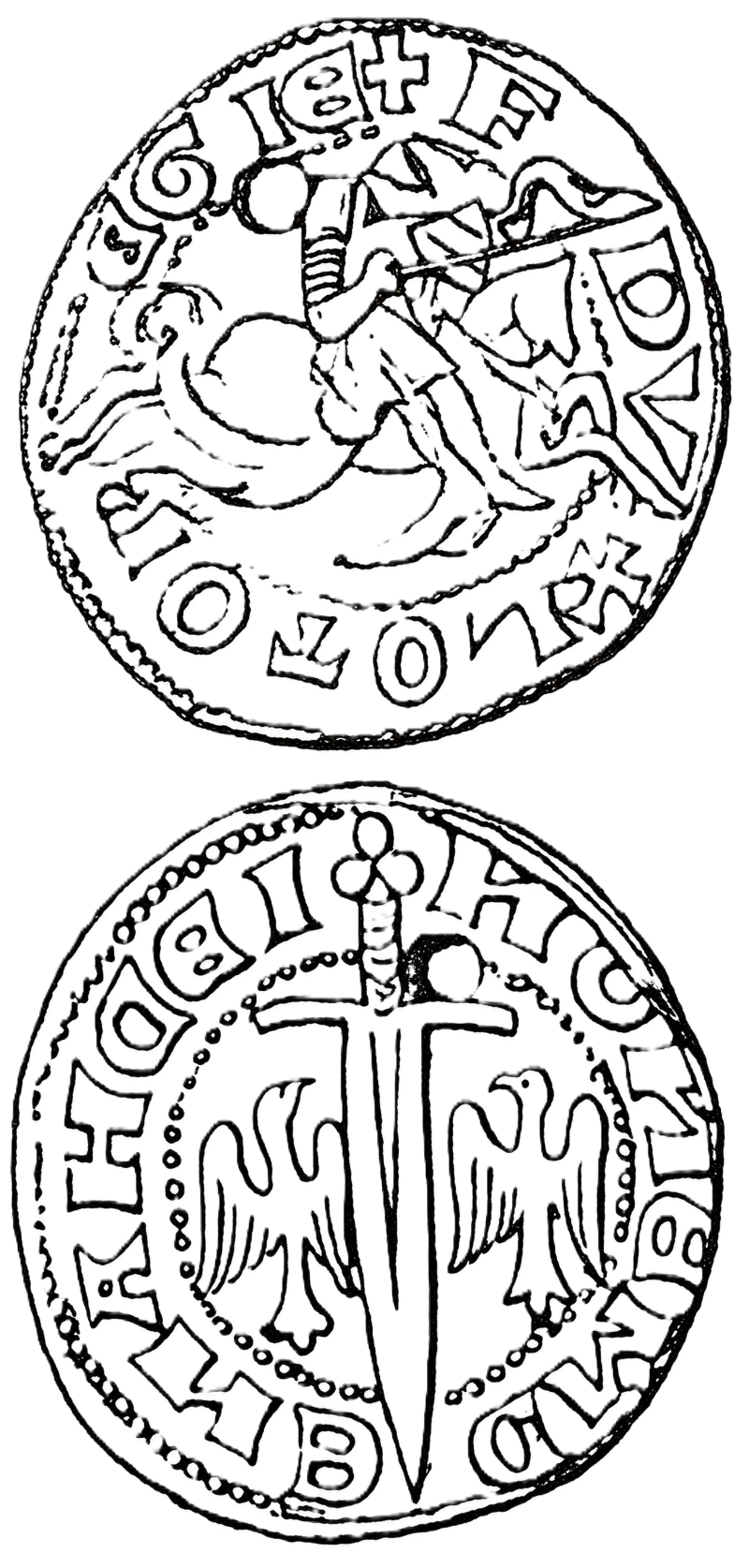
De Saulcy states that the earliest issues of Ferry IV continued the types of Thibaut II, changing principally the ruler’s name. These were the double spadin and spadin of Lorraine usage: a double denier and denier whose characteristic reverse displayed the ducal sword.
The horseman double denier has the obverse legend + F. DVX LOTOREGIE. An armed horseman gallops to the right, carrying a lance with a streaming banner and covering himself with a large shield. The reverse reads MONETA DE NANCEI and shows a sword point downward between two alerions. De Saulcy records an example from his own collection at 18 grains, or 0.972 g (Pl. III, 19). His plate supports the reading LOTOREGIE; the abbreviated form LORREGIE found in an English translation does not correspond to the published drawing.
De Saulcy also placed a duke-on-foot denier at the beginning of Ferry IV’s reign (Pl. III, 20). That attribution is no longer followed here. A modern reassessment presented by Jean Elsen in 2017 assigns the type to the final years of Ferry III. It is therefore discussed and catalogued under that ruler.
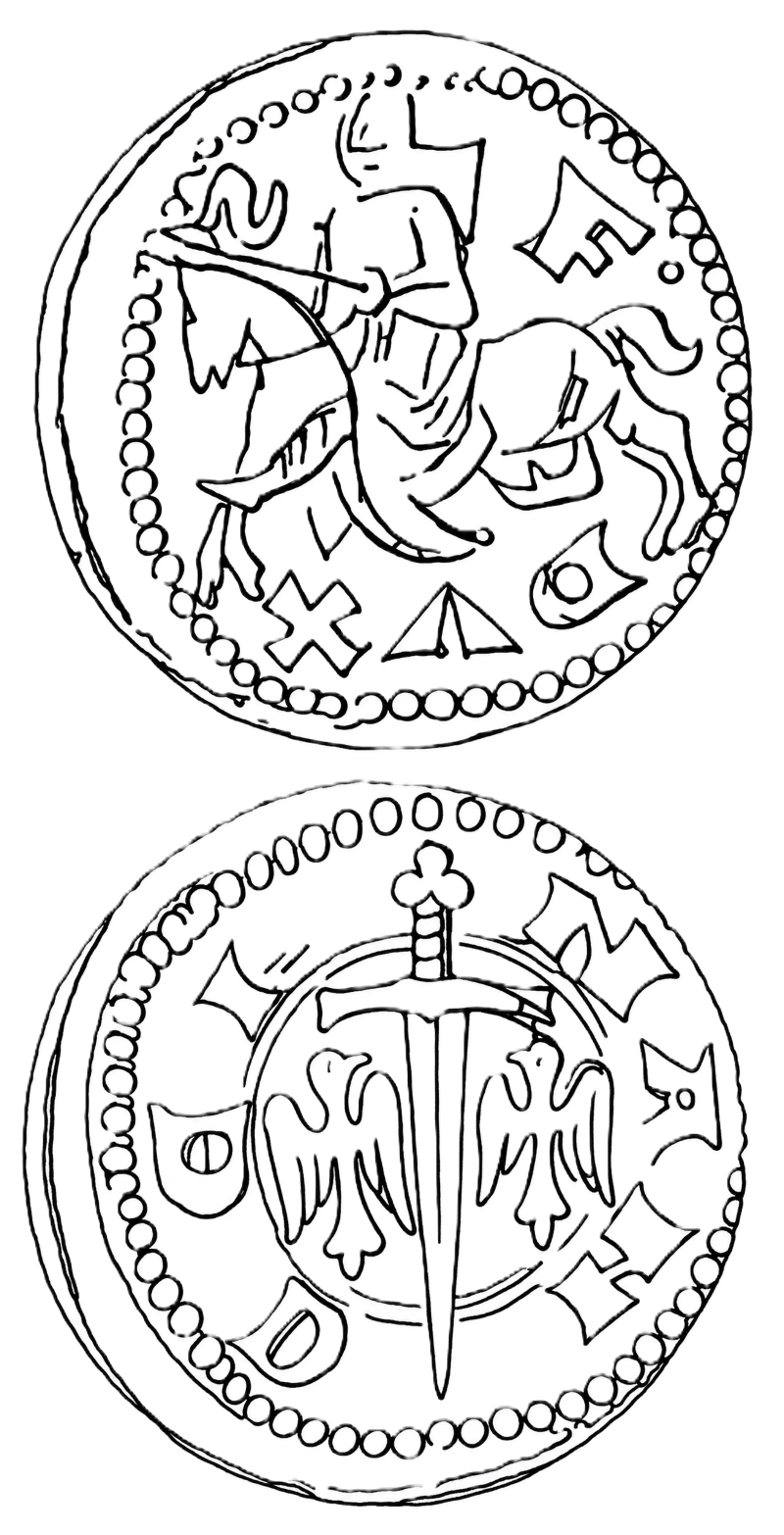
A second horseman denier retains the inherited design but reverses the direction of the rider. The obverse reads F. DVX and shows the horseman galloping left with lance, banner and shield. The reverse reads NANCEI, with the sword between two alerions. De Saulcy gives its weight as 8 grains, or 0.432 g (Pl. III, 21).
The plate depicts two details omitted from de Saulcy’s short description. The alerions stand side by side, wings displayed, within an inner circle crossed by the sword; a small shield charged with a bend also appears among the letters of the reverse legend. These features should be verified against surviving specimens before they are treated as fixed characteristics of the type, but they may eventually help distinguish dies or varieties.
De Saulcy compared this piece with a denier described by d’Elvange from the cabinet de Geneste. On that coin the horseman apparently galloped right, the ruler’s name appeared retrograde as FERICVS, and the reverse read NANCEI; its recorded weight was 9 grains, or 0.486 g. De Saulcy suspected an error in the method by which d’Elvange prepared his illustration. D’Elvange traced coins onto paper that was not fully transparent and may have reversed the tracing of one face before copying the other. Apart from the apparent reversal and the spelling NANCEII, the supposed variety did not differ substantially from the galloping-left denier.
The standing duke and the band of Lorraine
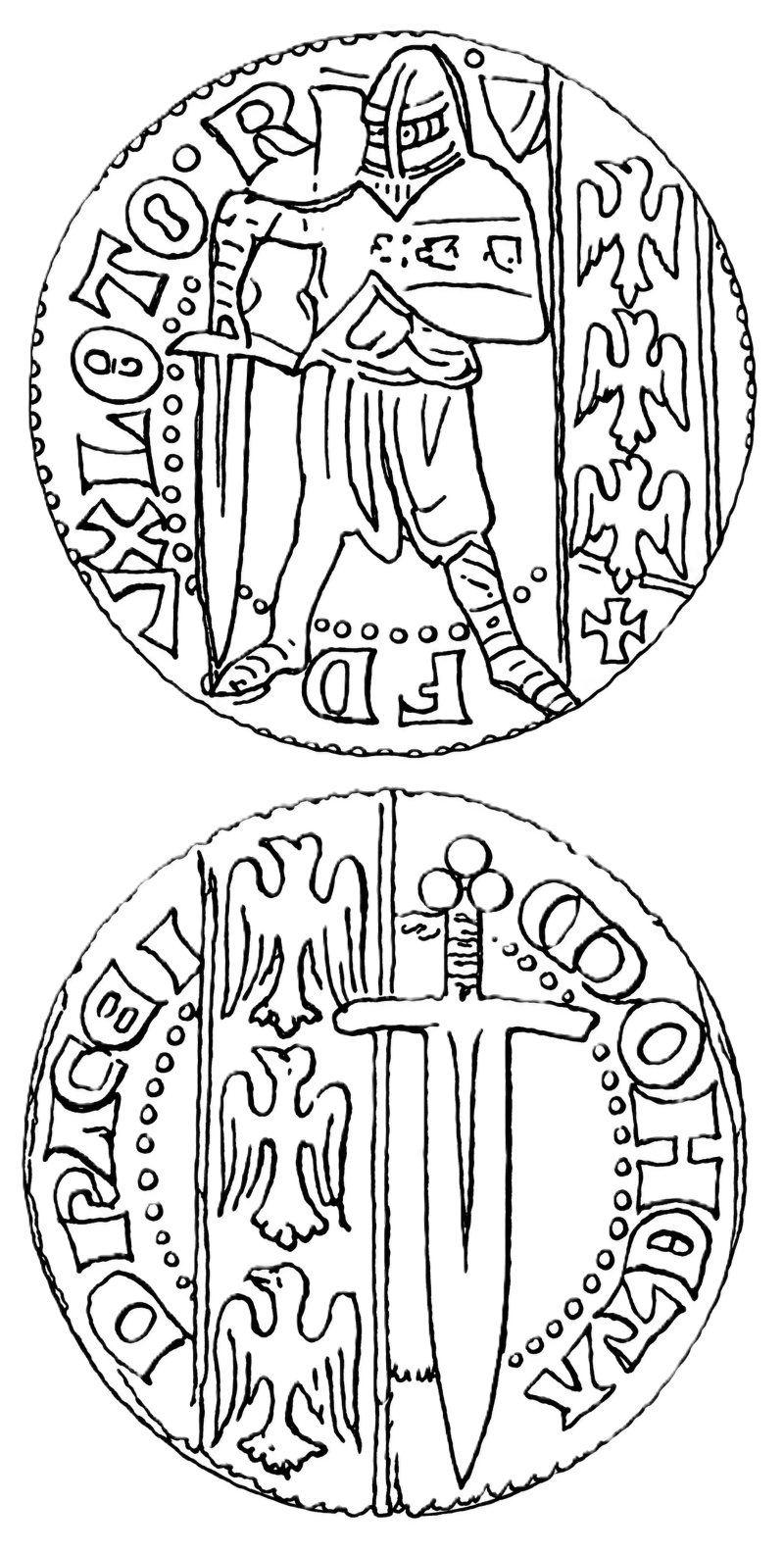
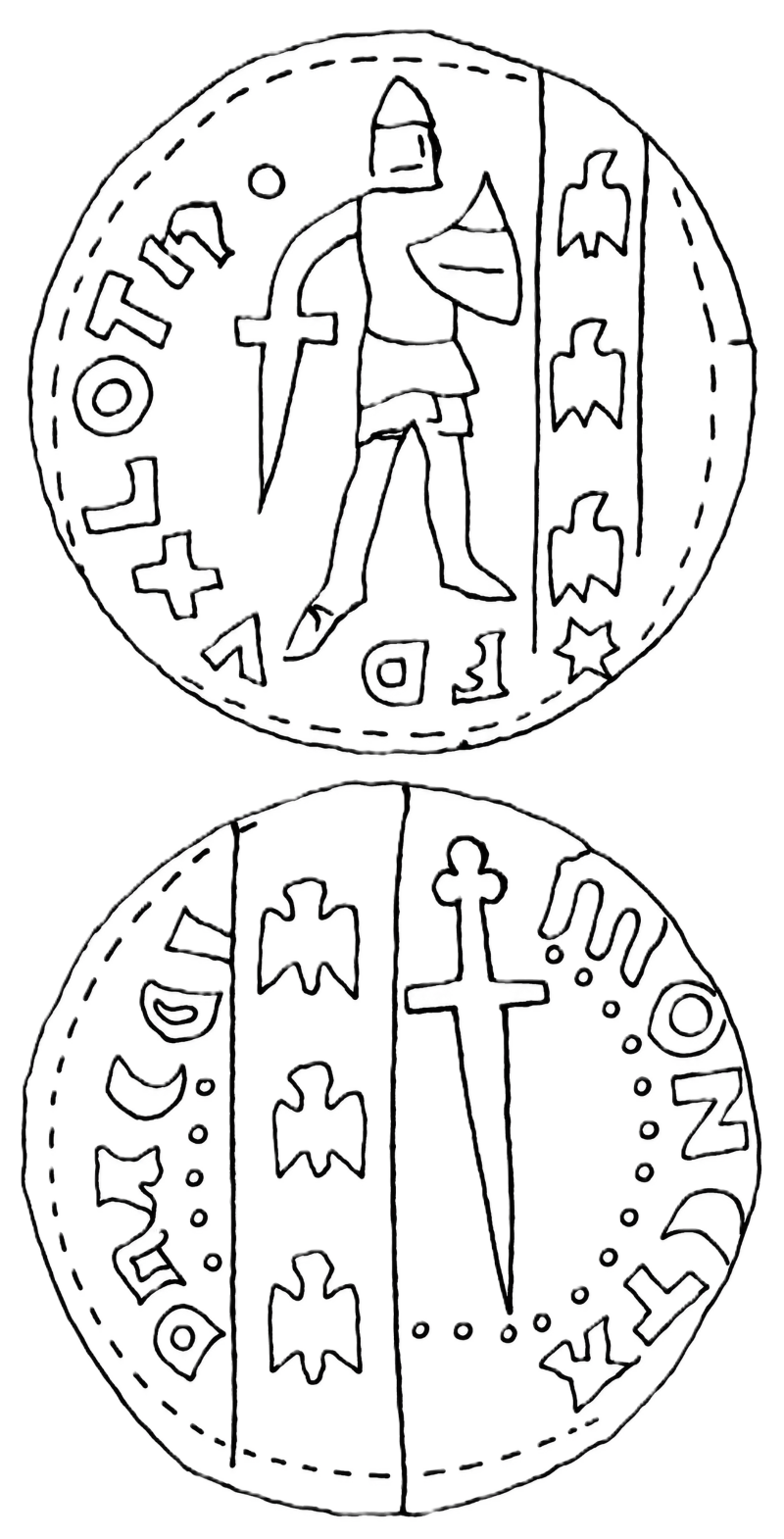
The most characteristic Nancy issue associated with Ferry IV replaces the mounted horseman with a standing figure of the duke. On the double denier, the duke faces the viewer, holding his sword point downward and covering himself with a shield bearing the arms of Lorraine. Behind his shoulders is a square object that de Saulcy described as a kind of cushion whose purpose he could not explain. It may instead represent an ailette: a heraldic plate attached to the shoulder of a knight’s harness and fashionable around 1290–1330. This identification is modern and remains interpretative.
Beside the duke is a vertical band charged with three alerions, one above another; some specimens also show a trefoil between his legs. The obverse legend is + F. DVX LOTOR. The reverse, MONETA D. NACEI, repeats the sword and the band. De Saulcy records specimens of 17 and 18 grains, or 0.918 and 0.972 g, from his own collection (Pl. III, 22–23).
The corresponding denier uses the same principal design and reads F. DVX LOTHO. De Saulcy records two examples from the collection of M. Bellot, goldsmith at Rambervillers, weighing 8 and 4 grains, or 0.432 and 0.216 g (Pl. III, 24). The exceptionally low second weight should not be treated as the standard of the denomination without evidence from additional specimens.
Dom Calmet and d’Elvange attributed this standing-duke type to John I, apparently reading the initial F as an I. De Saulcy rejected that attribution. The ruler’s initial may be poorly formed, but the vertical band of three alerions provides the safer diagnostic feature: it is not known on the coinage of John I.
The plates place the band at the viewer’s right on the obverse and at the viewer’s left on the reverse. This does not contradict de Saulcy’s statement that it stands to the duke’s left. The duke faces outward, so his own left is the viewer’s right; the reverse, which has no human figure, is described from the viewer’s position.
The drawings also indicate a possible denominational distinction at the foot of the band. The double denier appears to carry a small cross, whereas the denier appears to carry a mullet. If this difference is confirmed on surviving specimens, it would provide a more reliable means of separating the denominations than the ruler’s often indistinct initial. The denier’s legend also appears to preserve LOTHO, with an uncial h, rather than the LOTOR of the double denier.
De Saulcy records two further varieties from d’Elvange: one with MONETA NANCEI on the reverse and another with LOTORI in place of LOTOR.
The chronology is illuminated by the imitative coinage of Gaucher de Châtillon. After marrying Isabella of Rumigny, the widow of Thibaut II, Gaucher struck at Neufchâteau from 1318. His earliest pieces copied the horseman double denier; later ones copied the standing duke. The sequence shows that the horseman type remained a current model into Ferry IV’s reign and that the standing-duke type had appeared by the time Gaucher adopted it. It does not necessarily prove that the newer design immediately or completely replaced the older one.
The shield and star types
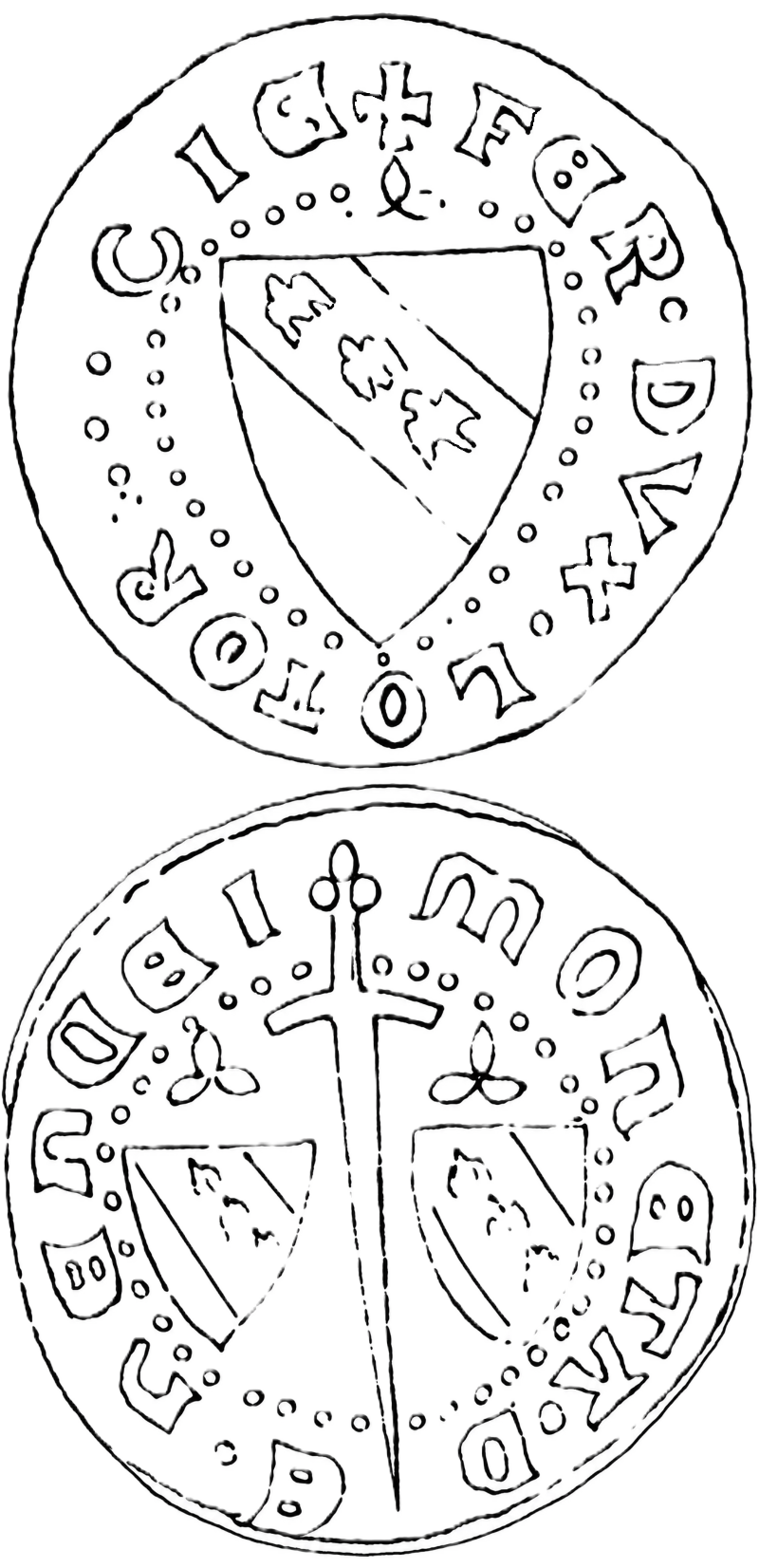
Another group abandons the figure of the duke and makes the arms of Lorraine the principal design.
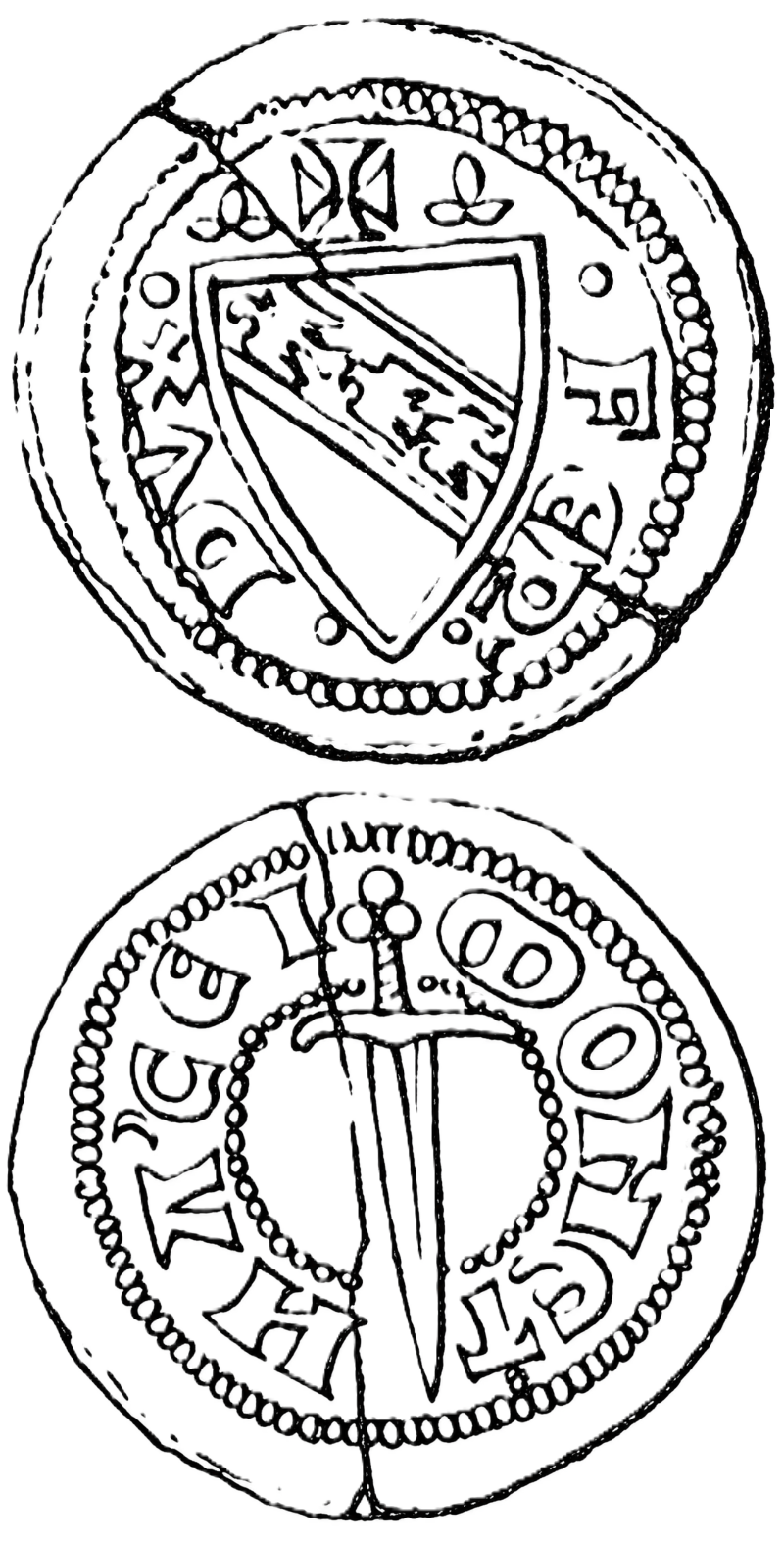
The shield-and-trefoil double denier reads + FER. DVX. LOTOR..GIE around the shield of Lorraine, with a trefoil above. Its reverse, MONETA DE NANCEI, shows a sword point downward between two shields of Lorraine, each surmounted by a trefoil. De Saulcy records a specimen from the cabinet de Geneste, known through d’Elvange, at 13 grains, or 0.702 g (Pl. IV, 1).
De Saulcy regarded the following piece as its denier. The shield of Lorraine stands beneath a cross between two trefoils, with .FER’. to the right and .DVX. to the left. The reverse reads MONET’ NA’CEI around a sword. The recorded specimen, from the cabinet Voillemier, weighed 8½ grains, or 0.459 g (Pl. IV, 2). The apostrophes are best understood as abbreviation marks rather than blundered letters. De Saulcy’s plate also depicts the sword crossing a beaded inner circle, a workshop feature shared with several horseman and star-and-shield issues.
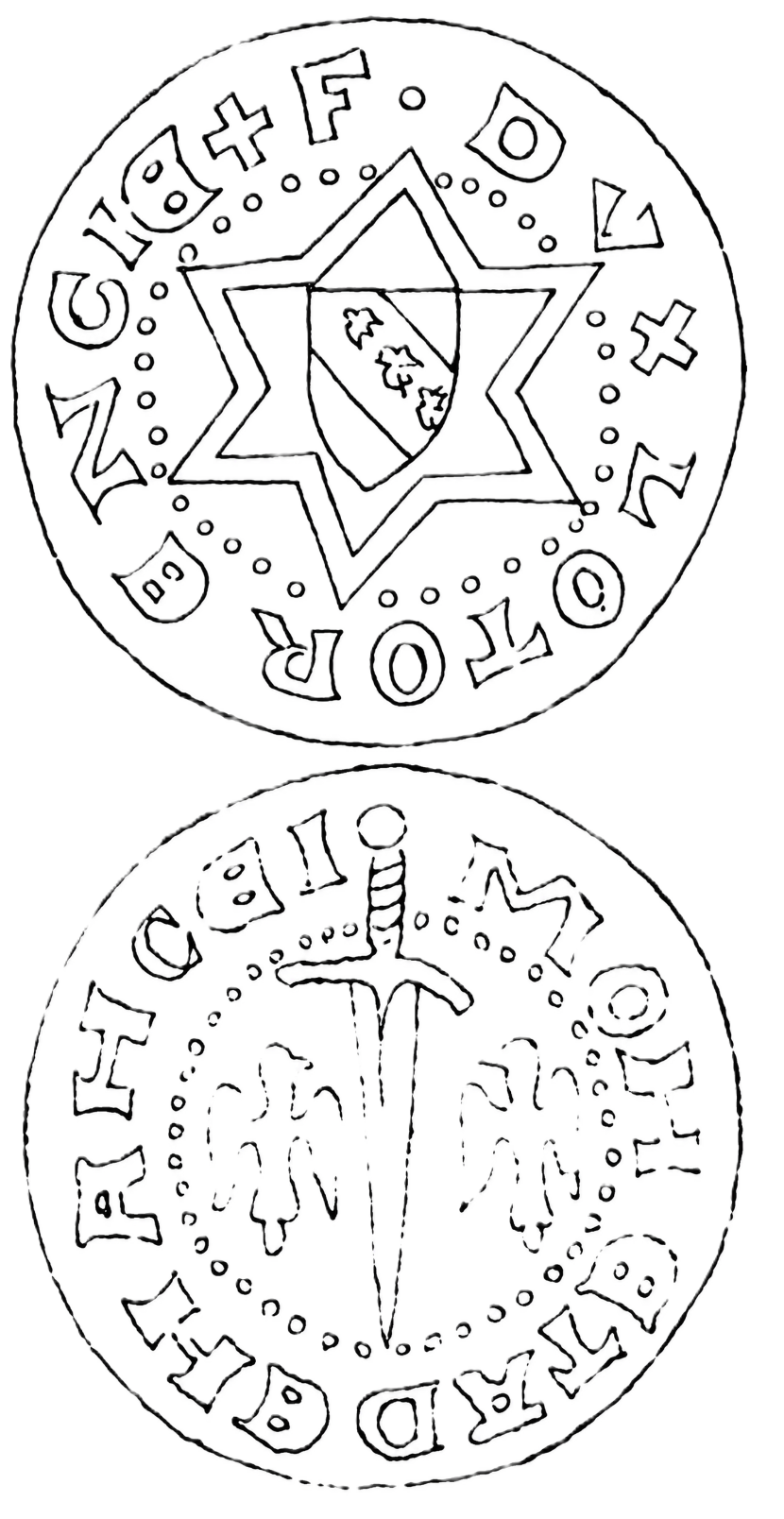
The next series places the shield of Lorraine at the centre of a six-pointed star. On several pieces the name FERRIC occupies the re-entrant angles of the star; their reverses provide the principal distinctions.
- A FERRIC star double denier has a cross fleuronnée and the reverse legend DVX LOTOREGIE. De Saulcy records it at 18 grains, or 0.972 g, from the cabinet de Geneste (Pl. IV, 3). He did not know a corresponding denier.
- Another FERRIC star double denier has a cross with small crosses at the ends of its arms. The cantons contain a square, a lozenge, a small cross and an alerion. De Saulcy printed its weight as 29 grains, or 1.566 g, but immediately questioned whether 19 grains, or 1.026 g, was intended. The specimen belonged to the cabinet Tiercelin (Pl. IV, 4).
- Its supposed denier has a cross hollowed at the centre and similarly varied symbols in the cantons. It is known to de Saulcy only from an inadequate figure published by Dom Calmet, and no weight is recorded (Pl. IV, 5).
- The star-and-shield double denier reads + F. DVX LOTORENGIE around the star, without FERRIC in its angles. Its reverse, MONETA DE NANCEI, shows the sword crossing an inner circle containing two alerions. De Saulcy records a specimen from the cabinet Charotte at 18 grains, or 0.972 g (Pl. IV, 6).
- A denier with FERRIC in the angles returns to the same sword-and-alerions reverse. De Saulcy records it at 6 grains, or 0.324 g, from the cabinet of Dom Brulant (Pl. IV, 7).
The attribution of this group requires caution. A double denier published by Laurent in 1848 uses the same star-based design but places THB’ where comparable pieces place FERRIC; its shield of Lorraine is differenced with a label. The label is appropriate to Thibaut as heir during the lifetime of Ferry III, and the piece is therefore placed before 1303. A related type was also copied at Épinal under a bishop of Metz who died in 1302. Together these parallels provide substantial evidence that at least some FERRIC star types belong to Ferry III rather than Ferry IV.
A later restitution study reportedly reassigned Plate IV, figures 4–7 as a consecutive group. The evidentiary boundary, however, does not coincide neatly with those plate numbers. The diagnostic feature is FERRIC in the angles of the star. It occurs on the cross-fleuronnée piece left outside that numerical run, whereas the star-and-shield double denier included within it has no FERRIC. The types should therefore be assessed by their legends, heraldry and relationships, not merely by their position on de Saulcy’s plate. Pending a complete re-examination of surviving specimens, the entire shield-and-star series should be labelled provisional or disputed rather than assigned without qualification.
Imitations of French royal money
De Saulcy attributed a remarkable group of French-style imitations to Ferry IV. Their designs copy familiar royal denominations, but their legends substitute a duke for a king, transform civic formulas into ducal ones, or reproduce royal names in blundered forms. These coins were evidently intended to resemble money already accepted beyond Lorraine. Their exact mint and official status remain uncertain.
The gros tournois
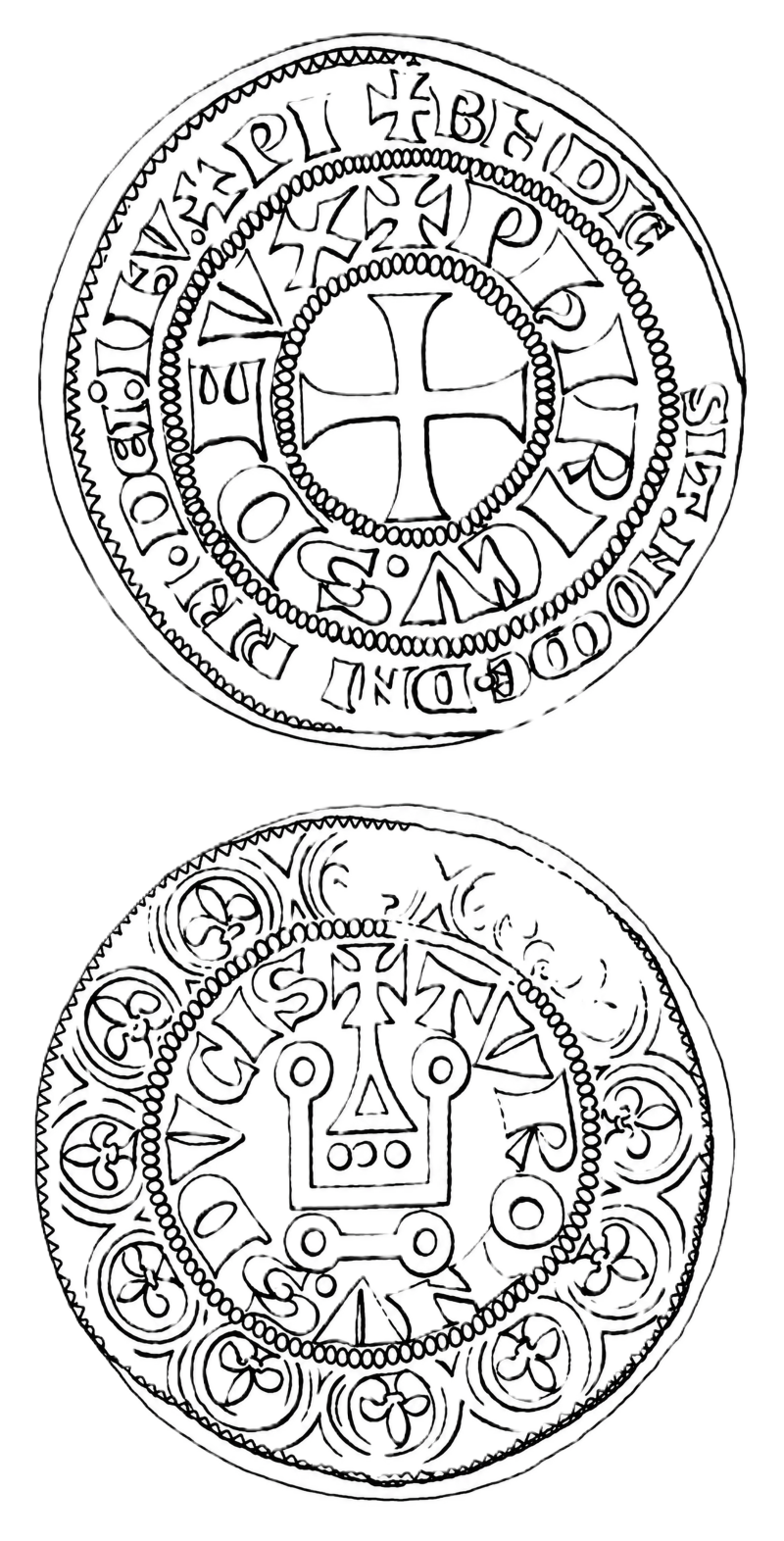
Two pieces copy the gros tournois. The first reads PHIRICVS DEVX, apparently for Ferricus dux, within the obverse, surrounded by the religious legend
- BHDICTVM. SIT. NOME. DNI. NRI. DEI. IHV. XPI. The reverse carries the usual châtel tournois but reads TVRONVS. DVCIS. De Saulcy records the specimen from the cabinet Norblin at 64 grains, or 3.456 g (Pl. IV, 8).
The second uses the obverse legend + LVTOREGIE DVX and the same imitative reverse. De Saulcy’s own specimen weighed 64½ grains, or 3.483 g (Pl. IV, 9).
The reverse provides the clearest distinction from French royal money. A royal gros reads TVRONVS CIVIS, identifying the city of Tours; these imitations read TVRONVS DVCIS. The replacement of civis by ducis converts a civic formula into a ducal one. The obverse offers a second test: a royal gros names a king with REX, whereas these pieces use DVX. Weight is less decisive but still significant. Both recorded examples fall well below the royal standard and are close to one another, suggesting a deliberately lower target rather than accidental loss from wear alone.
The maille tierce and denier parisis
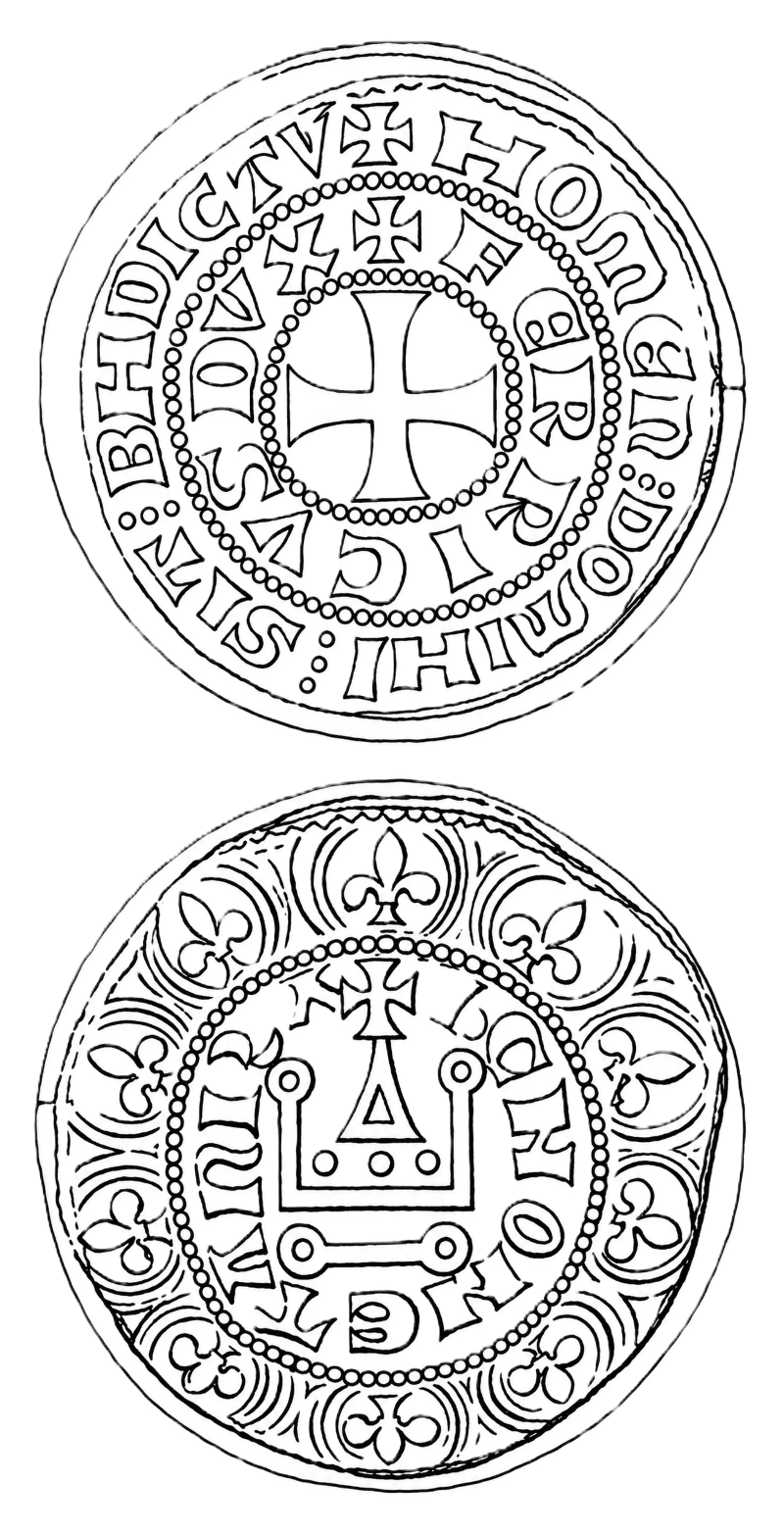
The maille tierce of Philip IV was copied in at least two forms. One reads
- FERRICVS DEVX around a cross, with the outer legend BHDICTV : SIT : NOMEN : DOMINI. Its reverse is of maille-tierce type and reads TVRONVS DVCIS. De Saulcy knew an unweighed example from the cabinet Rousseau in Paris (Pl. IV, 10); a specimen in the royal cabinet reportedly read DOMI for DOMINI.
A second piece reads + FERRICVS DVX with NOMEN : DOMINI : SIT : BHDICTV outside. Instead of the tournois formula, its reverse declares HC MONETA NRA, an abbreviated haec moneta nostra — “this is our money” (Pl. IV, 11). The legend openly asserts a separate issuing authority while the design retains the appearance of a familiar foreign denomination.
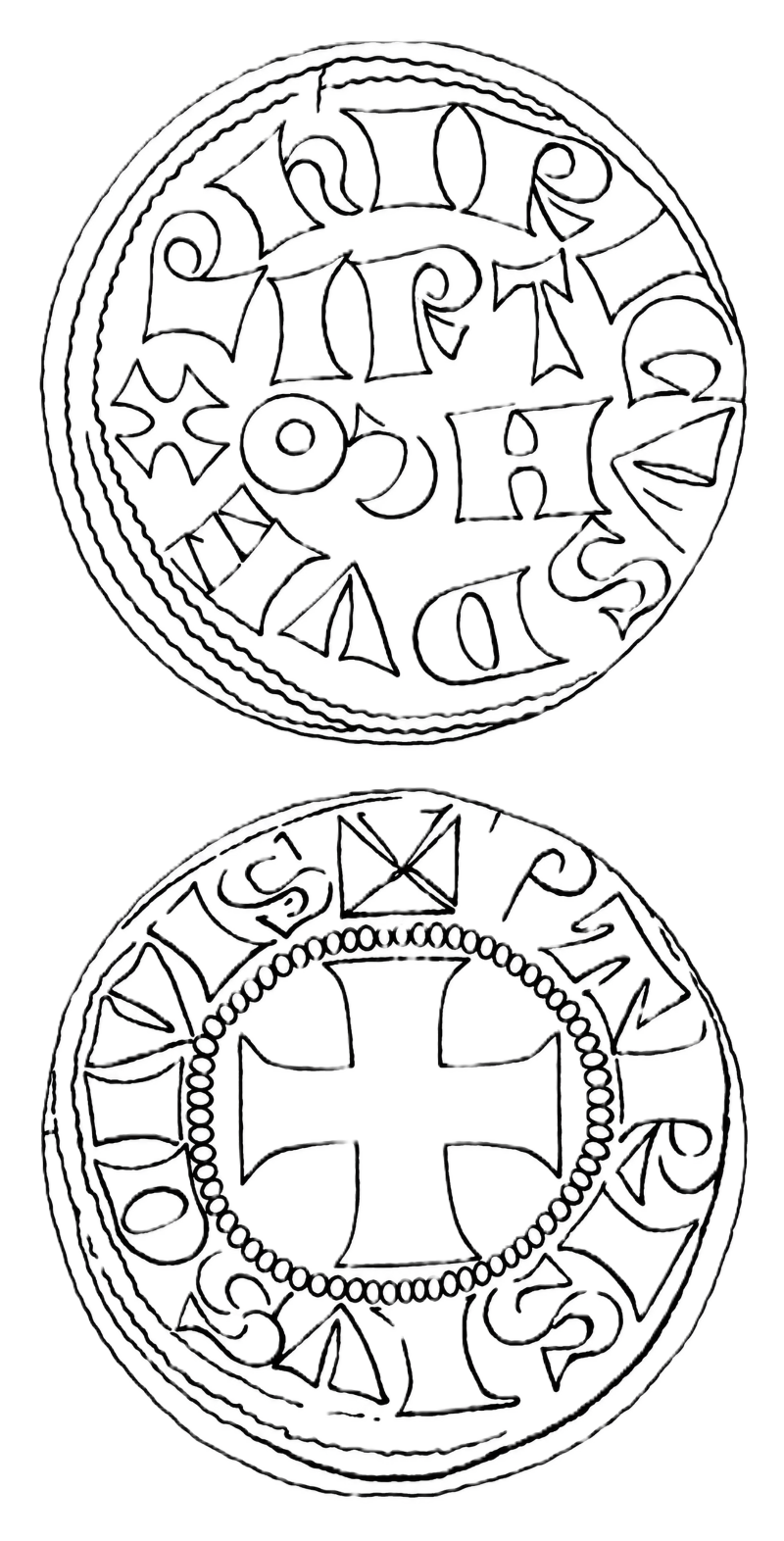
The denier parisis of Philip Augustus was likewise imitated in billon. The obverse reads PHIRICVS DVEX, with FRA above NCO in the field. The reverse reads PARISIVS CIVIS around a cross. De Saulcy’s specimen weighed 16 grains, or 0.864 g (Pl. IV, 12). He suggested that the continued circulation of worn older parisis made the type an attractive model: a newly struck piece of familiar appearance might be accepted more readily than a distinctly local coin.
The repeated opening PHI- in PHIRICVS deserves attention. It occurs on the gros, the denier parisis and the bourgeois fort, and resembles the beginning of PHILIPPVS. This may be no more than an engraver copying the opening letters of a royal model. It may also have increased the visual resemblance to French money. The hypothesis should remain provisional until the legends of all surviving French-style imitations have been compared systematically with those of the Nancy issues.
The bourgeois fort and the limit of its evidence
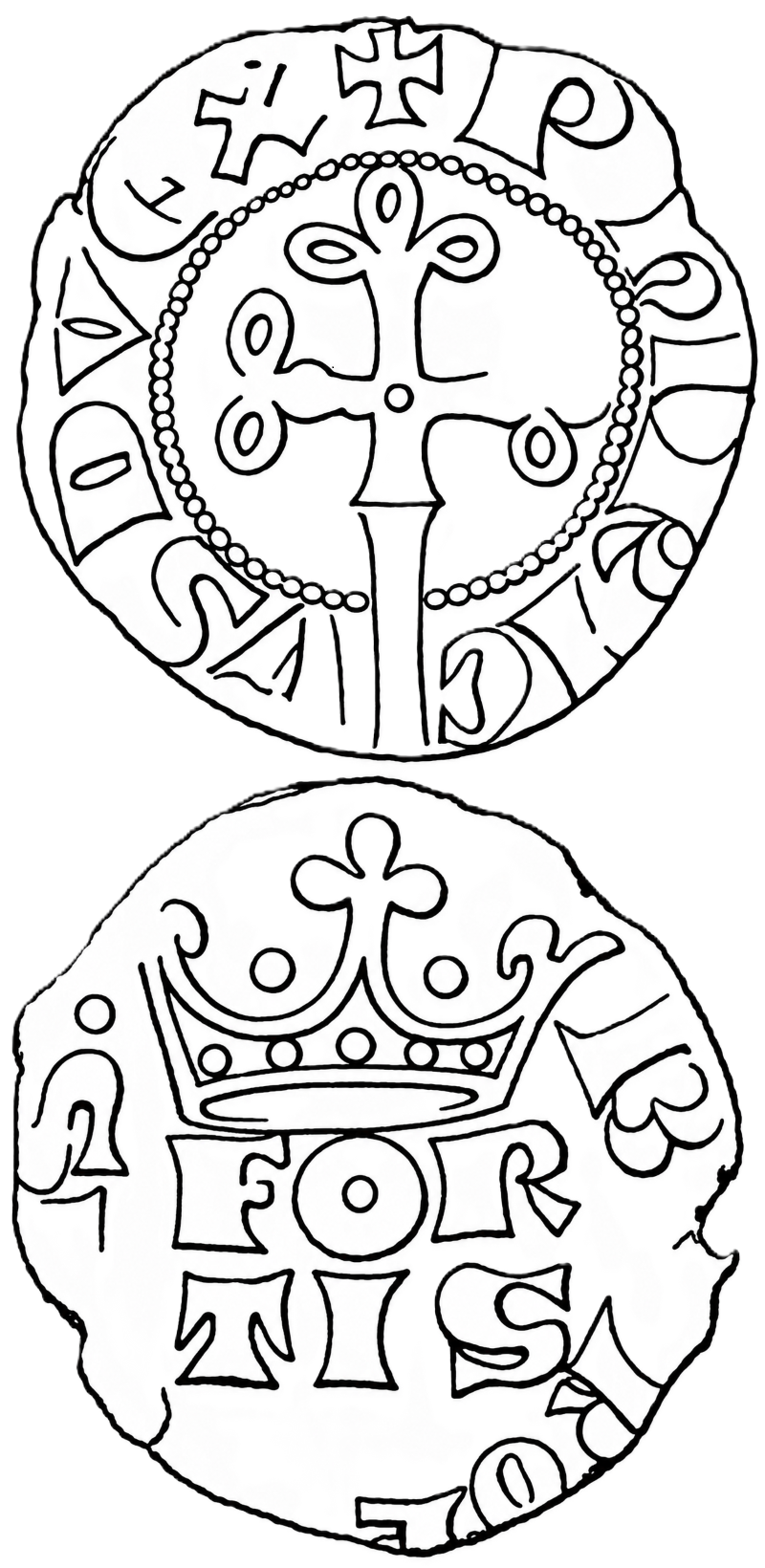
The imitation of the fort bourgeois reads PHIRICVS DVEX — although de Saulcy’s plate may depict DVX — around a cross fleuronnée of Bourges. The reverse reads BVRGENSIS, with a crown above FOR / TIS in the field and an annulet separating the two lines. De Saulcy’s specimen weighed 17 grains, or 0.918 g (Pl. IV, 13).
The type provides a firm terminus for this particular coin. The French forts bourgeois copied here were introduced under Philip IV on 20 January 1310; the imitation cannot be earlier than its model. Since Ferry IV succeeded in 1312, its legend and prototype make an attribution to his reign highly plausible.
The conclusion cannot automatically be extended to every preceding type. The gros tournois, maille tierce and parisis pieces copy older prototypes, and the Nancy shield and star issues copy no French denomination at all. Dating the entire group after 1310 would require independent evidence that the pieces formed a single contemporary emission — for example, shared punches, die links, common hoard evidence or consistent metrology. De Saulcy assumed a connection but did not demonstrate it.
Nor can the precise occasion of issue be established. De Saulcy suggested that Ferry IV might have ordered familiar-looking money for troops serving with French armies. The documented campaigns in Guyenne in 1324 and Flanders in 1328 make that explanation possible, but they do not prove it. The imitations may instead reflect the more general commercial advantage of issuing coins that resembled widely accepted royal money.
The esterlings
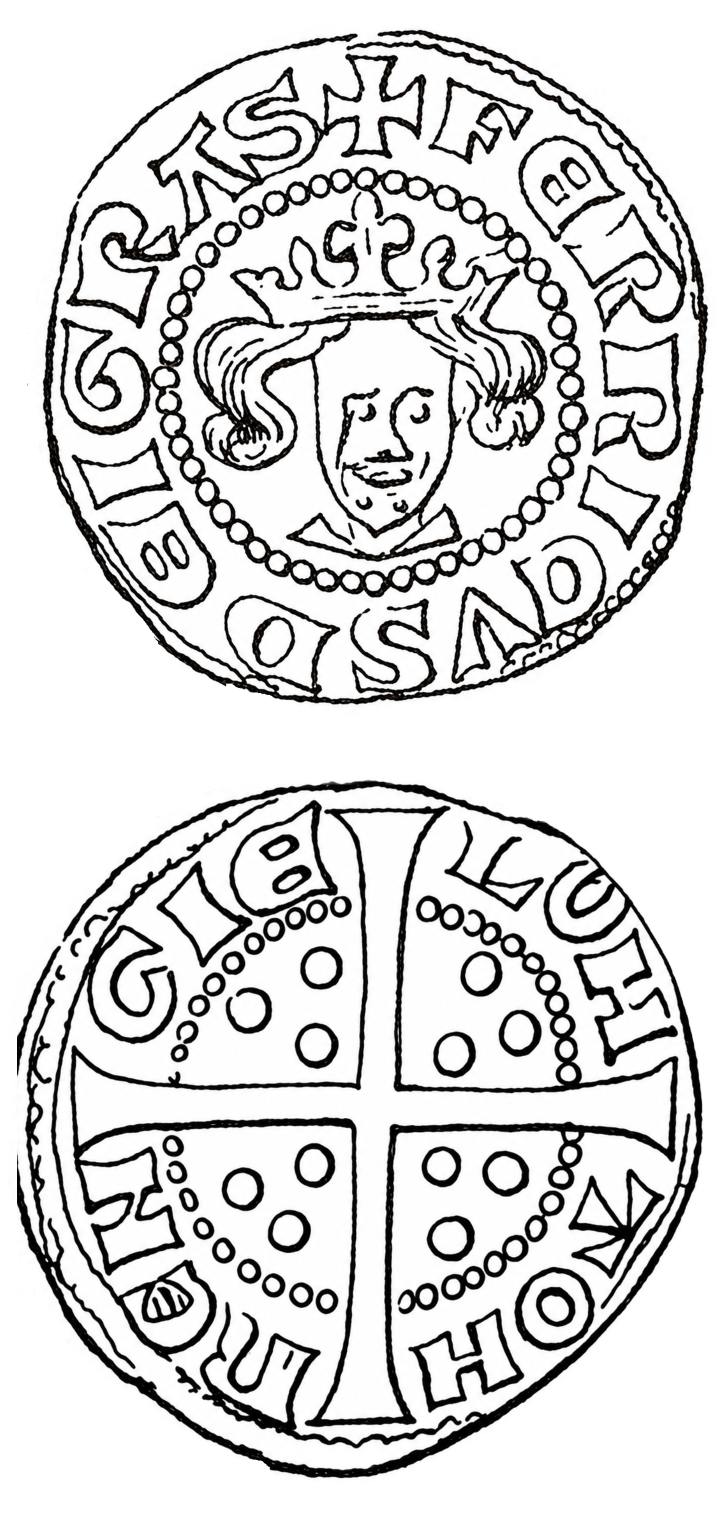
Ferry IV is also credited with esterlings modelled on English pennies, a type copied extensively by rulers in the Low Countries and the lands bordering Lorraine.
The first has a crowned facing bust surrounded by + FERRICVS DEI GRAS. Its reverse carries a long cross dividing the field into four quarters, each containing three pellets within a beaded arc. The legend is divided by the arms of the cross into four groups: LON / TON / REN / GIE. De Saulcy’s specimen weighed 16½ grains, or 0.891 g (Pl. IV, 14).
The arrangement is more revealing than the complete word. English pennies divide their mint legend quarter by quarter, and a penny of London begins one quarter with LON. The Lorraine imitation does the same. Its spelling appears to have been chosen or adapted so that the first portions of the reverse would resemble LONDON when the coin was seen quickly. This is strong evidence of deliberate visual imitation, although it does not by itself establish where or under what legal authority the piece was struck.
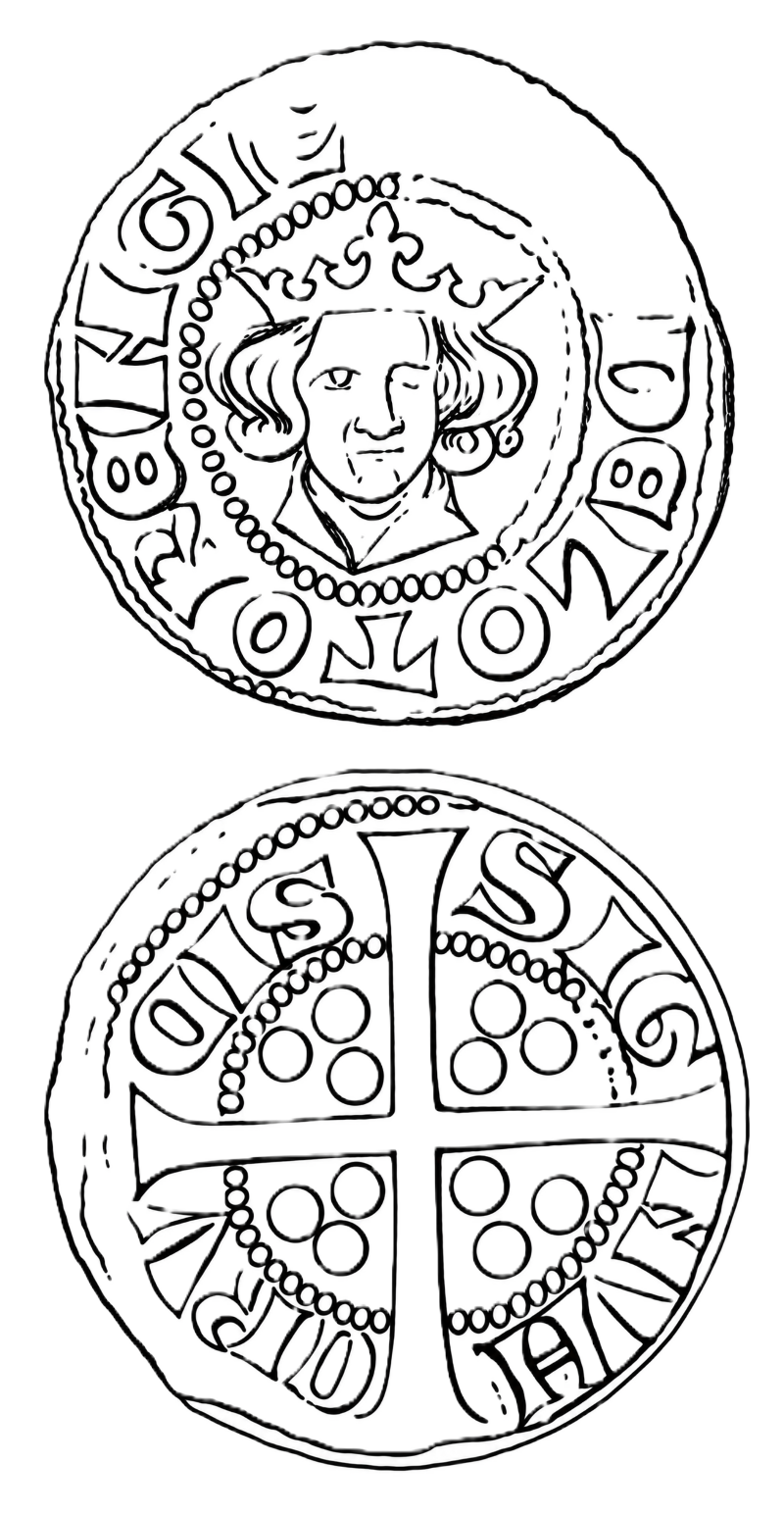
De Saulcy described the obverse only as a facing royal bust. His plate depicts it wearing a crown, consistent with the English prototype; confirmation from the original coin or another surviving specimen would nevertheless be preferable.
A second esterling reads + … DE LOTORENGIE around a facing bust. The reverse bears SIGNVM CRVCIS and the same long-cross design. De Saulcy supplied the lost opening word as DVX and recorded a weight of 16 grains, or 0.864 g (Pl. IV, 15). Its plate shows a crowned bust as well, though de Saulcy describes this obverse simply as a facing bust.
The second esterling is worth setting beside the first, because it uses the same die layout to no deceptive end. Its reverse legend divides into SIG / NVM / CRV / CIS — four groups of three letters in the quarters of the cross, exactly the arrangement that makes LON / TON / REN / GIE resemble an English penny of London. Here the four groups carry an ordinary religious formula. The quartering is therefore a property of the type and not of the imitation, which strengthens rather than weakens the reading of the first piece: the engraver did not invent a layout to exploit, he chose a spelling that would fall into the layout he already had.
De Saulcy associated these coins with Ferry’s campaigns in Flanders, where English esterlings circulated widely and would have been readily accepted by soldiers and merchants. That is a plausible historical setting, not a demonstrated occasion of issue. The coins are better understood more generally as money designed to travel: they identify a Lorrainese duke, yet use the visual language of internationally familiar currency.
Metrology and method
De Saulcy’s weights are internally consistent. He used the Paris grain at 54 mg and employed half-grains where necessary. Thus 18 grains equals 0.972 g, 17 grains 0.918 g, 13 grains 0.702 g, 8½ grains 0.459 g, 8 grains 0.432 g, and 16½ grains 0.891 g. Apparent discrepancies reported in an English translation result from transcription errors rather than from de Saulcy’s calculations.
These converted weights must nevertheless be interpreted cautiously. In most cases they represent a single specimen rather than a denominational standard. Wear, clipping, corrosion and the quality of nineteenth-century weighing may all affect an individual result. A reliable reconstruction of Ferry IV’s monetary standards will require a larger corpus of surviving specimens, with modern weights, diameters, metal analyses, provenances and die relationships.
Assessment
The coinage traditionally associated with Ferry IV does not form a single, fully settled series. The band-of-Lorraine issues provide the clearest distinctively ducal type of the reign. The inherited horseman pieces show continuity with Thibaut II, while the shield and star groups preserve unresolved questions reaching back into the reign of Ferry III. The French and English imitations reveal a different monetary strategy: the adoption of foreign forms that already possessed credibility outside Lorraine.
The most important conclusion is therefore not that Ferry IV abandoned local coinage for imitation, but that two monetary languages existed side by side. One expressed ducal identity through the sword, the alerions and the arms of Lorraine. The other sought acceptance by looking familiar in French and international markets. The surviving evidence does not yet allow every type to be dated or assigned with certainty, but it shows a coinage responding both to dynastic tradition and to the practical demands of circulation beyond the duchy.