
Biography
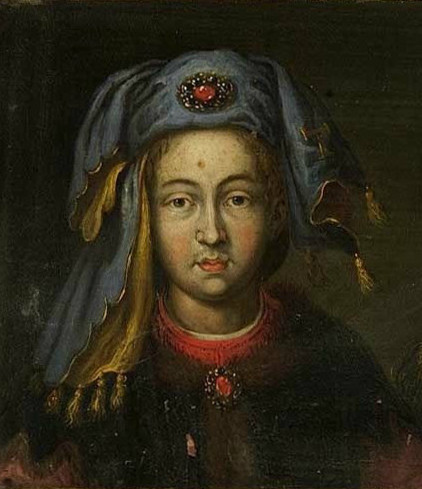

Thibaut II — Theobald in the English literature, Thiébaut or Thiébaud in the French — was born in 1263, the eldest son and heir of Ferry III of Lorraine and Margaret of Champagne.1 A marriage agreement between him and Isabella of Rumigny, daughter of Hugh, lord of Rumigny, was drawn up as early as 1270, when both were still children; the marriage itself was celebrated on 23 May 1278. Through it Thibaut acquired the lordship of Rumigny, and it is under that style that he appears in his father’s later years — most visibly in 1299, when he represented the ailing duke at the meeting of Albert of Austria and Philip IV at Vaucouleurs.
Long before succeeding to the duchy, Thibaut had acquired military experience in the service of both imperial and French interests. On 2 July 1298 he fought on the side of Albert of Habsburg at Göllheim in the Palatinate, the battle that older French writers place simply “near Spire”.2 Adolf of Nassau, Albert’s rival for the German kingship, was defeated and killed in the engagement, clearing the way for Albert’s formal election as King of the Romans later that same month. Four years later, on 11 July 1302, Thibaut served in the army of Philip IV of France against the Flemish militia at Courtrai, where the French suffered a disastrous defeat.
Ferry III died at Nancy on 31 December 1303, and Thibaut succeeded him as Duke of Lorraine without contest.3 His accession did not interrupt his military association with the French monarchy. On 18 August 1304 he fought with Philip IV’s army at Mons-en-Pévèle, where the king confronted the Flemish forces in a long and indecisive battle that nevertheless allowed France to recover from the humiliation of Courtrai.
The same year offers the clearest single illustration of how Thibaut governed. While he rode with the French host in Flanders, his heir was married to Elisabeth of Austria, daughter of the very Albert of Habsburg for whom he had fought at Göllheim six years before. Nothing states the position of a Duke of Lorraine more economically: the duchy belonged to the Empire and its ruling house bound itself to the Empire’s king by marriage, while the duke himself campaigned under the banner of France. Thibaut broadly continued his father’s policy of cooperation with the Capetians without ever conceding that cooperation amounted to dependence. Their lands lay within the Empire, but proximity to Champagne and the possession of fiefs held from its counts drew the dukes steadily into the political orbit of the French crown.
Philip IV appears to have regarded Thibaut as a trusted intermediary. Following the campaigns in Flanders the duke was appointed, together with the Duke of Brabant and the Count of Savoy, to take part in the negotiations with the Flemings. He subsequently received the French king at Nancy and later visited the royal court in Paris.
During this visit Thibaut rendered homage for the particular territories that the dukes of Lorraine held from the county of Champagne, rather than for the duchy itself. These possessions included Neufchâteau and associated lands in the western part of the duchy. Champagne had come to Philip IV through his marriage to Joan of Navarre, so that the king exercised, in right of his wife, the feudal rights formerly belonging to the counts of Champagne.4 The obligation long outlived him: it is said to have continued into the fifteenth century, until in 1465 Louis XI released John II, Duke of Lorraine and Duke of Calabria, from the requirement to render homage for Neufchâteau in recognition of his services to the French crown.5
From Paris, Thibaut accompanied Philip IV to Lyon, where Pope Clement V was crowned on 14 November 1305. His presence at the ceremony further demonstrates the standing he had acquired among the princes associated with the French court.
Soon after his return to Lorraine, Thibaut turned his attention to the succession. In August 1306 he summoned an assembly of the Estates of Lorraine at Colombey-les-Belles to determine what should happen if the direct male succession were interrupted. At the duke’s proposal the assembly confirmed the principle that, if a duke’s son died before his father, the children of that deceased son should inherit before the son’s brothers — and that the rule applied to daughters as well as sons. It therefore recognised the right of representation within the direct line, and permitted female descendants to succeed in the circumstances the ordinance defined.
The decision should not be read as establishing an unrestricted right of female succession. Its immediate purpose was to ensure that the descendants of a deceased heir would take precedence over collateral relatives such as the reigning duke’s brothers. Nevertheless it affirmed an important principle of Lorrainese dynastic custom: the direct line was to be preferred to collateral branches even where that line continued through women. In this the ordinance differed from the exclusion of women that emerged in the succession to the French crown during the crises of 1316 and 1328 — an exclusion justified by systematic appeal to Salic law only afterwards, and largely in the following generation. The Lorrainese settlement of 1306 is therefore best understood within the traditions and immediate political needs of the duchy, rather than as a response to a fully developed French doctrine of royal succession that did not yet exist.
The last years of the reign brought a harder test of what the French alignment required. On 13 October 1307 Philip IV ordered the arrest of the Templars throughout his kingdom, and in November Clement V extended the instruction to rulers beyond it. Lorraine lay outside the kingdom, so that Thibaut acted not as a subject of Philip but under papal authority — a distinction that mattered a good deal in form and very little in outcome. The order’s houses in the duchy were broken up and their property taken into ducal hands; later accounts report that some of the brethren were put to death.6 The affair closed only at the Council of Vienne, where Clement V suppressed the order in March 1312, a few weeks before Thibaut’s own death. It is the least edifying episode of the reign, and the one that shows most plainly how far a Duke of Lorraine would follow the French crown once the papacy had given him cover to do so.
Like several of his predecessors, Thibaut eventually became involved in a serious conflict with the Bishop of Metz. The dispute arose from a tithe imposed by Clement V upon ecclesiastical revenues. The collection of the levy in the region was entrusted to the Duke of Lorraine, but Renaud de Bar, Bishop of Metz, refused to permit its collection within the territories under his authority.
The disagreement soon developed into an armed confrontation. Renaud obtained the support of his nephew Edward I, Count of Bar, and of the Count of Salm. In 1308 their combined forces advanced against Frouard — the stronghold commanding the Moselle valley north of Nancy that Ferry III had fortified half a century earlier against these same neighbours — and placed it under siege.
Thibaut marched to relieve the fortress with a force that later accounts describe as considerably smaller than that of his opponents. The precise course of the engagement is difficult to reconstruct, but the episcopal coalition was decisively defeated. According to later Lorrainese narratives, the duke’s men occupied the heights above the attackers and rolled or hurled great stones down upon them as they attempted to advance. The forces of Metz and their allies suffered heavy losses; Edward of Bar and the Count of Salm were captured and released only on payment of substantial ransoms. The victory secured Thibaut’s immediate position and demonstrated that the duke could still defend his authority against a powerful coalition of Metz, Bar and Salm.
Thibaut II died on 13 May 1312, after a reign of little more than eight years, and was buried at Beaupré. Shortly before his death he founded or reorganised a collegiate church dedicated to Saint Nicholas at Darney, one of the residences associated with the ducal family and a lordship that would pass to his second son.
Thibaut and Isabella of Rumigny had several children. He was succeeded by their eldest son Ferry, born on 15 April 1282 at the ducal residence of Gondreville, who ruled as Ferry IV from 1312 until his death and whose repeated participation in the wars of his age earned him the epithet le Lutteur — “the Fighter”, or “the Wrestler”.7 Of the younger children, Matthias held Darney, Boves, Blainville and Florennes; Hugh succeeded to Rumigny, Martigny and Aubenton; and the daughters Mary, Margaret and Isabella married into the houses of Châtillon, Dampierre and Bar respectively.
Although Thibaut II’s reign was brief, it occupies an important place in the political development of medieval Lorraine. His career reflects the duchy’s position between France and the Empire — a position he managed, in the single year 1304, by fighting for one and marrying his heir into the other. The succession settlement of 1306 strengthened the principle of dynastic continuity in the direct line, and his victory at Frouard preserved ducal authority against the recurring challenge of the bishops of Metz and their regional allies.
Notes
-
Some genealogical compilations imply that Thibaut became heir only on the death of an elder brother Matthias. The reading is almost certainly mistaken. Thibaut appears consistently as the eldest son of Ferry III, and a marriage contract drawn up for him in 1270, at the age of seven, is intelligible only if he was already the heir. The Matthias who died in 1281 or 1282 was a younger brother, lord of Beauregard. Confusion is easy because Thibaut’s own second son was likewise named Matthias — and it is that Matthias, not the uncle, who held Darney. ↩
-
The battle in which Adolf of Nassau was killed on 2 July 1298 is now conventionally named for Göllheim, in the Palatinate. Nineteenth-century French sources, Saulcy among them, habitually place it près de Spire — near Speyer — which lies some forty kilometres away. Note also that Albert had been elected once already, on 23 June 1298, by the princes opposed to Adolf; the election of 27 July, after the battle, was the formal and effectively unanimous one. He was never crowned emperor by the pope and should be styled King of the Romans. ↩
-
A number of older works and genealogical databases give Ferry III’s death as 31 December 1302. The discrepancy is very probably an artefact of the medieval year of grace, which in much of France began at Easter: 31 December 1302 more gallico is 31 December 1303 in modern reckoning. The date used here is the one adopted throughout this site. ↩
-
Philip IV married Joan I of Navarre, Countess of Champagne, in 1284 and held Champagne in her right; she died in 1305. The county was not formally united with the royal domain until 1314, on the accession of their son Louis X. At the time of Thibaut’s homage, therefore, the king was acting as Joan’s husband rather than as Champagne’s outright sovereign — a distinction of some consequence for the form of the act. ↩
-
The remission of 1465 rests on Saulcy and the tradition deriving from him, and deserves caution. John II of Lorraine — John of Calabria — spent that year in arms against Louis XI as a leader of the League of the Public Weal. Any grant made to him in 1465 is far more likely to belong to the concessions extracted from the king at Conflans and Saint-Maur in October than to any service rendered to the crown. ↩
-
The Lorraine episode of the Templar suppression is thinly served by the accessible literature, and the account above should be treated as provisional. The claim that brethren were executed in the duchy derives from the modern encyclopaedic tradition rather than from a source consulted here, and that tradition anchors the episode to a “Council of Lyon” — presumably a confusion of the royal visit to Lyon in 1305 with the Council of Vienne of 1311–12, since no council met at Lyon in these years.
↩ -
Ferry IV’s death is variously given as 23 August 1328, 23 August 1329 and 21 April 1329, and the end of his reign is accordingly reported as either 1328 or 1329. The 1328 date rests on Bogdan; the 1329 dates circulate widely in the genealogical literature. No date is stated in the text above pending verification against Saulcy.
↩
Part II
Coinage
Thibaut II’s coinage divides cleanly at his accession, and the division is the most interesting thing about it. For three years before he became duke he struck in his own name at Neufchâteau, as heir presumptive and by royal licence; for nine years afterwards he struck at Nancy as duke. The two groups differ in mint, in type and in what they were permitted to say — and the difference is not a matter of fashion but of rank. Few reigns in this series show so plainly that a coin type could be a constitutional statement.
What follows rests chiefly on F. de Saulcy’s Recherches of 1841, which remains the fullest account, together with a later article that used one of Thibaut’s own coins to overturn part of it.
Neufchâteau, by royal licence
Neufchâteau came to Thibaut with his marriage to Isabella of Rumigny, together with the lordships of Châtenois and Frouard. The town lay within the county of Champagne, and after Philip IV acquired Champagne in right of his wife Joan of Navarre, striking there was no longer a matter for the duke of Lorraine alone. A personal concession from the French crown was required. It was granted by letters patent issued at Orléans in June 1300, on the express condition that the coin should not circulate in France. Saulcy supposed the accompanying homage to have been rendered at the meeting of Albert of Austria and Philip IV near Vaucouleurs, where Thibaut represented his father, whom illness kept at Nancy.
Saulcy is unusually candid about the inference he had drawn from this document sixteen years earlier, and withdraws it. In his Observations numismatiques of 1835 he had concluded that the dukes could not have struck at Neufchâteau before 1300. He now regarded that as plainly wrong: Ferry III had certainly had deniers made there, and the concession of June 1300 shows something narrower. After Philip IV’s marriage to Joan of Navarre in August 1284, a formal and personal grant became necessary before anyone could exercise the right of coinage in a lordship answering to Champagne. Saulcy’s suggestion is that Philip, once free to grant or refuse regalian rights in a fief of his crown, withheld them from Ferry III, and that the letters patent of 1300 were needed before Thibaut — lord of Neufchâteau since his marriage — could strike there at all.
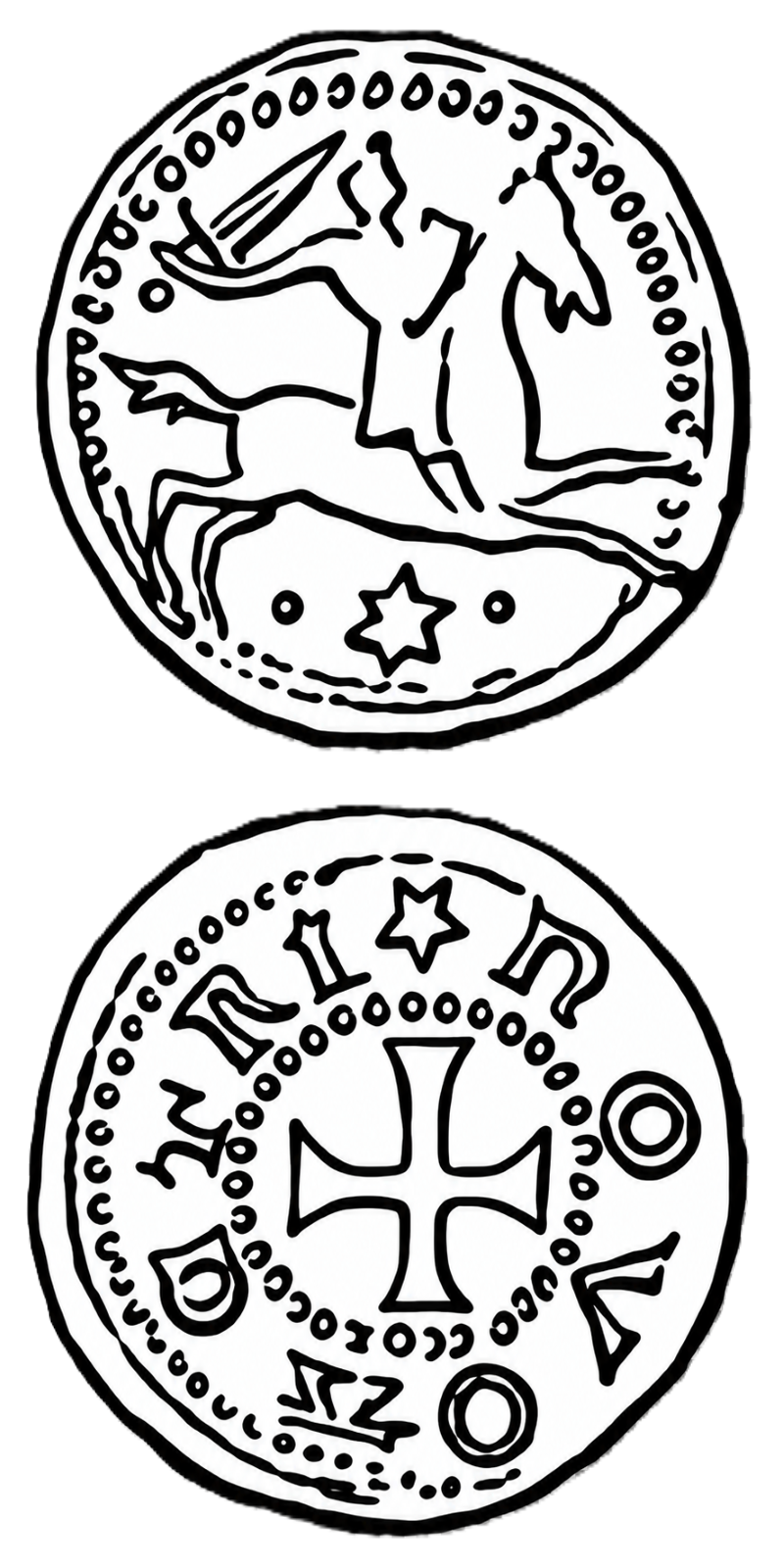
The deniers themselves carry the armed horseman, with a star or molette between two dots beneath the horse. The reverse legend appears as NOVOCATR, NOVOCATRI, NOVCATRI or NOVICASTRI, some with an initial cross. Saulcy records weights of 0.595, 0.648 and 0.595 g for the three specimens in his own collection — 11, 12 and 11 grains — illustrated at Plate III, figures 12 to 14. A variety without the flanking dots, reading NOVOCATI, weighs 0.567 g or 10½ grains (Plate III, figure 15).
What the heir was not allowed to strike
The horseman is a deliberate copy of his father’s. Thibaut needed his coin to pass without difficulty throughout Lorraine, and the surest way to achieve that was to make it look like the money already in everyone’s hands. On Saulcy’s reading, that is exactly what he did.
But the copying stops at the reverse, and stops for a reason. Ferry III’s deniers carry the sword of the marchis, and that type belonged to the reigning duke alone. Thibaut, as heir presumptive, had no right to it, and put a plain cross in its place — le type banal de la croix, in Saulcy’s dismissive phrase. The moment he succeeded, the sword appears on his money at Nancy. Whatever the dignity of marchis did or did not amount to administratively, its emblem was evidently not available to a man who had not yet inherited it.
Saulcy adds a linguistic argument for the attribution. From Mathieu I to Ferry III the ducal legends are consistently in the Romance vernacular; Thibaut’s, without exception, are Latin — on these Neufchâteau deniers and on the ducal coins of Nancy alike. The change of language coincides with the change of ruler, and gives an independent reason for placing this group where he places it.
The evidence of the Lunéville hoard
For the metal itself Saulcy is unambiguous: in fineness and in the number of coins cut to the mark, Thibaut conformed exactly to the ordinances in force in the ducal mints. The hoard evidence bears him out. In the Lunéville find, Thibaut’s Neufchâteau deniers lay mixed indiscriminately with those of Ferry III struck at Nancy, at Mirecourt, and at Neufchâteau itself. They were not distinguished in circulation because there was nothing to distinguish: same standard, same weight, same appearance at arm’s length.
This is the strongest single argument in the whole account, and worth marking as such. Style and legend are matters of judgement; a hoard is a fact about what was actually circulating together.
The label, and a coin that moved a reign
In 1848 Laurent published a double denier of the same star-bordered type, bearing the arms of Lorraine differenced with a label. Its obverse reads THB’ where the comparable pieces read FERRIC, and the reverse carries LORINGIE divided by the arms of a fleuroned cross.
The curator of the museum at Épinal could not place it. The label, he reasoned, showed that the coin could not belong to a duke of Lorraine, since such differences marked cadet branches; nor could it belong to Thibaut while he was still lord of Rumigny; and yet the style was plainly of the end of Ferry III’s reign. He was reduced to wondering whether some other Thibaut of Lorraine — Calmet’s fourth son of Thibaut II, lord of Prény — might have struck it.
The later article corrects him on the heraldry, and the correction settles the coin. A label was not reserved to younger sons: the heir apparent, in his father’s lifetime, differenced the family arms with one. The example given is Robert II of Béthune, who before succeeding to Flanders sealed with the arms of Flanders differenced by a label of three points, and whose label disappears from his seals once he became count. Read that way, the piece belongs to Thibaut, son of Ferry III and husband of Isabella of Rumigny, in the years when he was striking at Neufchâteau by the concession of 1300.
So the heraldry and the reserved sword type say the same thing twice over, in two independent languages. An heir might use the family arms, marked as an heir’s; he might use his father’s obverse, but not his father’s reverse.
The consequence reaches beyond Thibaut. If the labelled piece is necessarily earlier than 1303, and if it copies the FERRIC star-bordered type, then that type cannot belong to Ferry IV, who did not reign until 1312. The article accordingly reassigns Saulcy’s Plate IV, numbers 4 to 7, from Ferry IV to Ferry III, and supports the move with the imitations: the double denier was copied at Neufchâteau, while at Épinal, under Gérard de Relanges as bishop of Metz (1298–1302), the denier was copied so closely that the bishop’s initial G and title EPCOP occupy the re-entrant angles of the same six-pointed star, and the mint name stands in the quarters of the same cross pattée. A less direct imitation followed at Toul. Datable imitations of that kind fix the prototype near 1300 independently of any argument from style.
One implication deserves flagging, because the two sources conflict and neither notices. Saulcy claims his Nancy double denier is the first coin in the Lorraine series with a known subdivision. If the star-bordered double denier belongs to Ferry III, that claim fails: denominations above the simple denier were already circulating in the duchy before Thibaut succeeded. The article says as much, and treats it as the chief interest of the reassignment. This catalogue records both positions rather than choosing between them.
The ducal coinage of Nancy
The coins Thibaut struck as duke are few and, in Saulcy’s judgement, generally rather rare. They are also markedly better made: he thought the art of die-engraving took an immense step forward in Lorraine during this reign, and the double denier is his evidence.
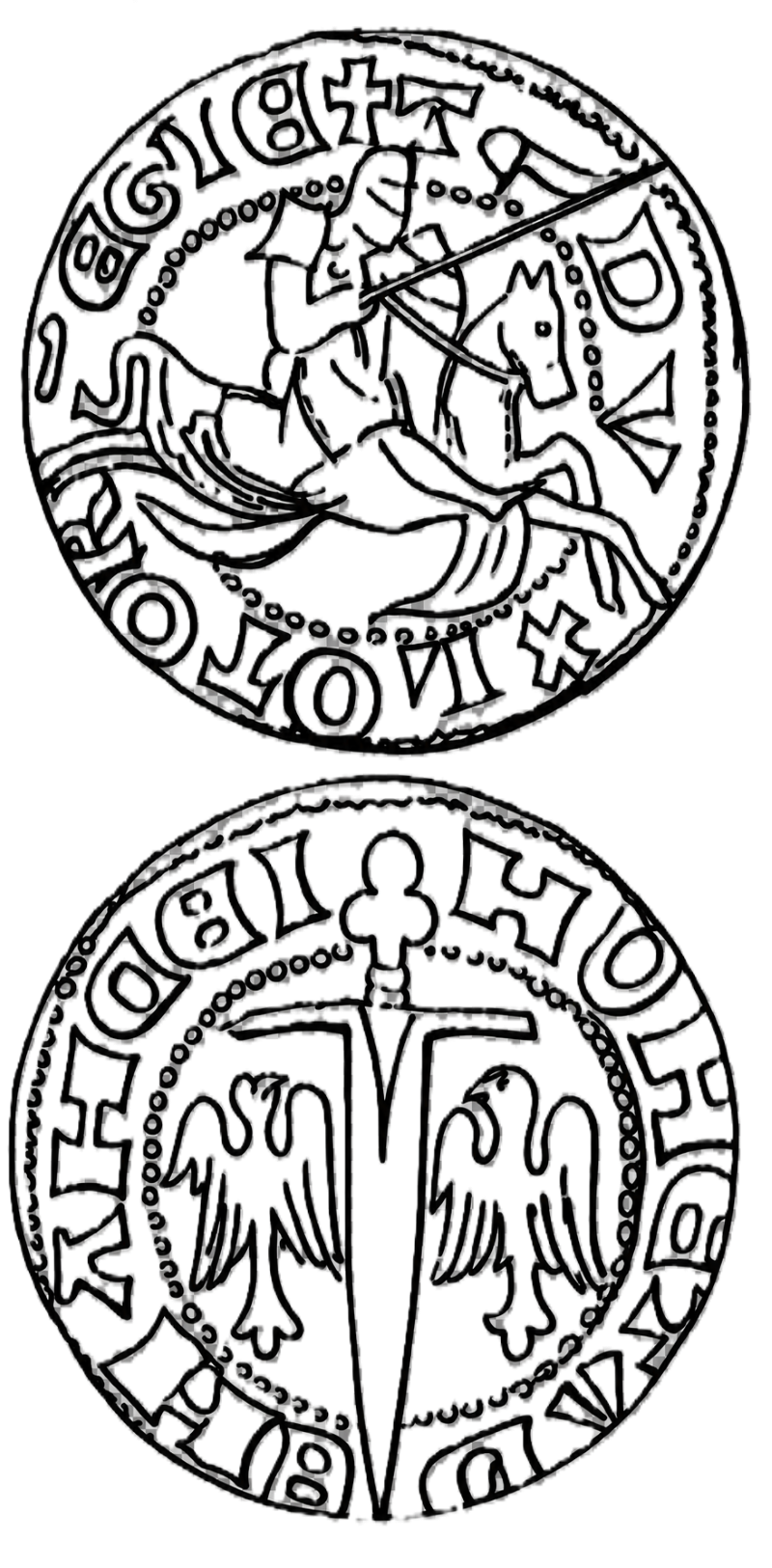
The double denier reads + T. DVX LOTOREGIE around an armed horseman covering himself with his shield and carrying a banderole; the reverse, MONETA DE NANCEI, shows the sword point downward between two alerions. It weighs 0.972 g, or 18 grains (Plate III, figure 16). Here the sword returns, and the shift from the heir’s plain cross could hardly be more pointed.
A variety of the same weight lacks the inner beaded border, and carries the banderole between the D and the V of the legend rather than between the T and the D, so that the letters T and D stand together before it. Saulcy saw it in the cabinet of M. Voillemier. He also records a contemporary piece he took to be the work of a counterfeiter, reading LVTOREGIE for LOTOREGIE, in poor billon and weighing only 0.648 g against the 0.972 g of the genuine coin — a third less metal, which is presumably the point of the exercise.
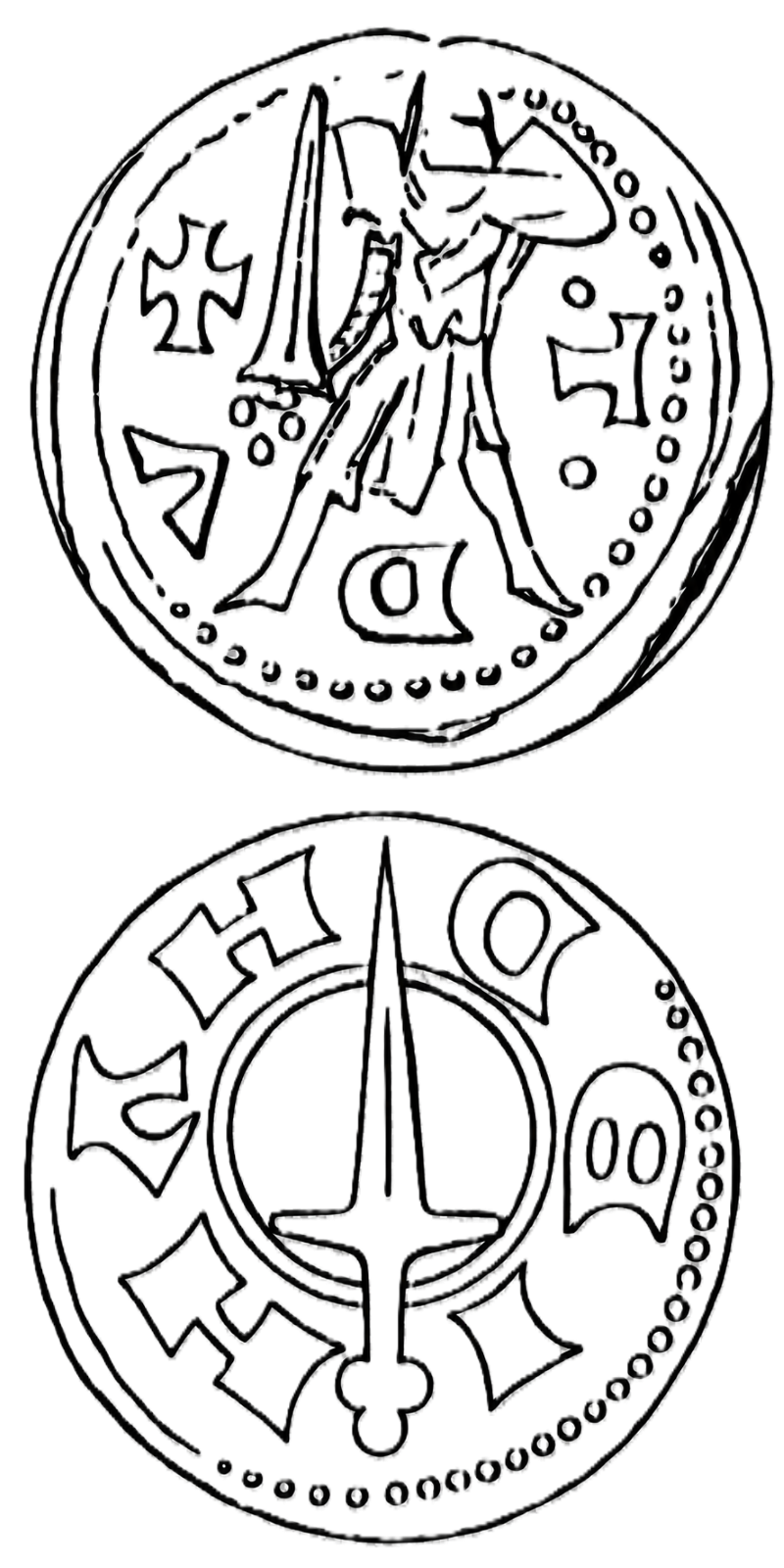
The simple denier reads .T. DVX, with the duke on foot, helmeted, covering himself with his shield and holding a sword in his right hand; the reverse carries NANCEI and a sword. It weighs 0.486 g, or 9 grains (Plate III, figure 17). The duke-on-foot obverse invites comparison with the F. DVX denier discussed under Ferry III, whose attribution has itself been moved in recent years; the two types should be studied together, not least because a misread initial is exactly the kind of accident that shifts a coin from one reign to another.
Two lighter pieces are recorded at second hand. D’Elvange found, in the collection of M. Charroyer, curé of Gircourt, a variety of this denier whose reverse had no inner circle in place of the beading, and whose legend differed in a reading that the copy consulted here has garbled; it weighed 0.432 g or 8 grains. A smaller specimen belonging to M. Dupont, a tobacco farmer at Nancy, weighed only 0.216 g or 4 grains — less than half, which is a large enough gap to raise the question whether it is the same denomination at all.
On both of these coins the duke carries a square object above his right shoulder. Saulcy takes it for a piece of armour but confesses he cannot guess its use. The modern identification is straightforward, and he could not have been expected to make it: it is an ailette, the small heraldic plate laced to the shoulder of a knight’s harness, in fashion from roughly 1290 to 1330 and therefore precisely right for a coin of this reign. The suggestion is offered here as a modern reading and should not be attributed to Saulcy.
A type known only on paper
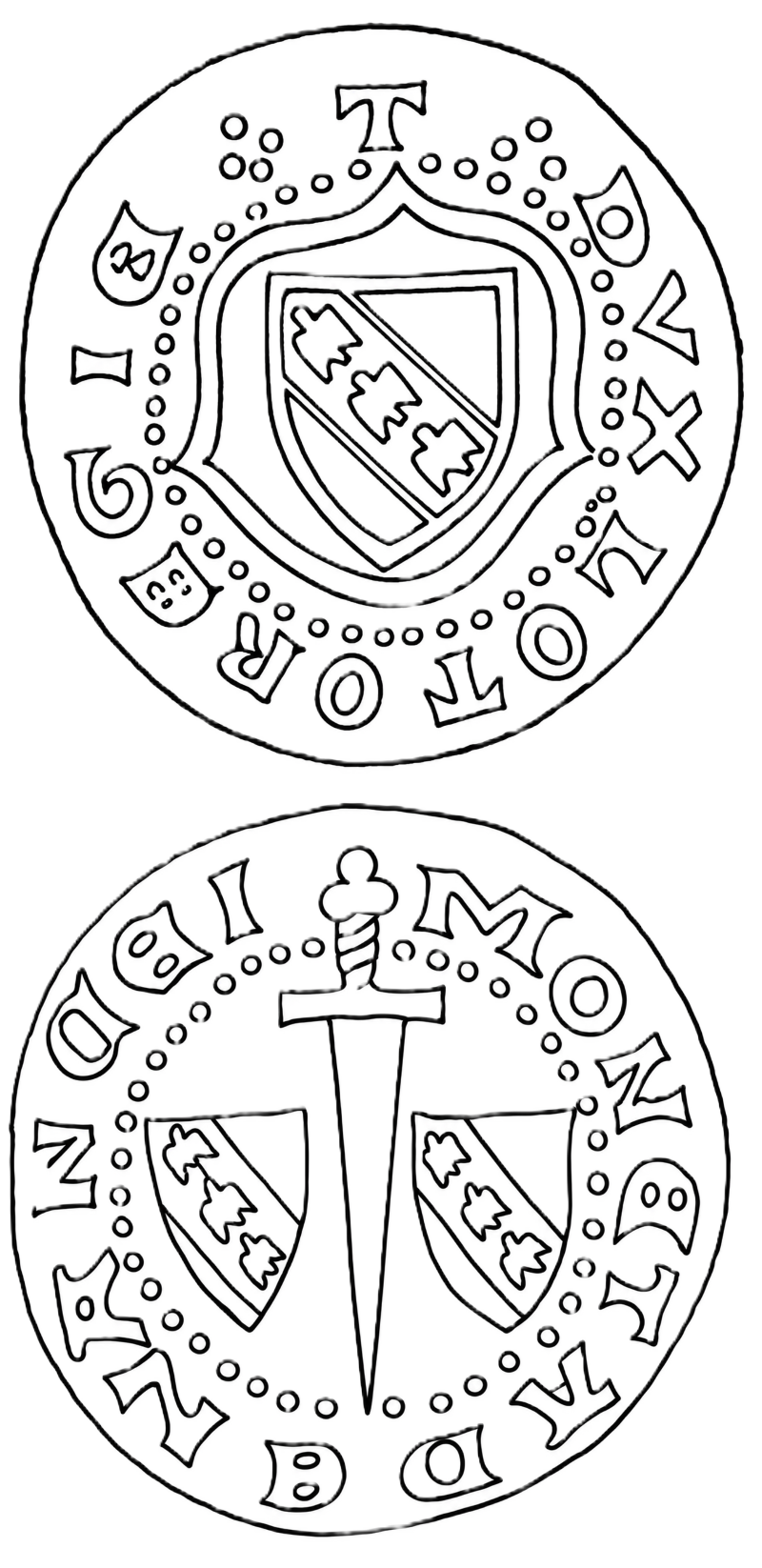
One further coin appears in the literature, and Saulcy never saw a specimen of it. He knew it from the manuscript collections of Baleicourt and d’Elvange, and reproduced a corrected drawing of the example d’Elvange had recorded in the possession of M. de Montureux, canon of the primatial church of Nancy. It reads T. DVX LOTOREGIE, with a rose or fleuron on either side of the T, and the shield of Lorraine within a curvilinear cartouche; the reverse, MONETA DE NANCEI, has the sword point downward between two shields of Lorraine. The recorded weight is 0.972 g, or 18 grains (Plate III, figure 18).
Saulcy then doubts his own placement of it. The type struck him as later than Thibaut’s reign, and he asks whether it might be a coin of Ferry IV, or even of Raoul, carried too far back by a faulty reading — adding that only the sight of the piece itself could decide.
By the standard applied elsewhere in this catalogue, that settles how it should be treated. A type known from a drawing of a drawing, whose own publisher expected it to belong to a different reign, is unconfirmed. It is recorded here because doubt has to be visible before it can be resolved, but it should not be listed among the coins of Thibaut II as though a specimen were known.
The mint as an institution
Thibaut’s reign is the first in this series to leave much administrative trace alongside the coins, and the documents are worth as much as the types.
On 25 May 1307 he issued a regulation concerning the master and officers of the mints, taking them under his safeguard and protection and freeing them from all tailles, gabelles, subsidies and other levies ordinary and extraordinary. The exemption extended to the widows of the workers for as long as they did not remarry. The text survives in the manuscript collections of ducal ordinances known as the Code Rosselange and the Reboursel; Saulcy took the note from d’Elvange, whose work he credits with having gathered the scattered facts of Lorraine’s monetary history into one place.
In 1308, when Othon de Granson, bishop of Toul, farmed out his mint, the contract reserved to the duke of Lorraine the right to use his own dies within the lands of the bishopric, in accordance with an agreement made between them beforehand. Saulcy cites Dom Benoît’s Histoire de Toul, p. 468.
Shortly before his death Thibaut made a will directing that tailles should thereafter be paid in coin current within the duchy. Saulcy reads this as evidence that foreign species had at some earlier point been cried down in Lorraine — a reasonable inference, though the ordinance that would prove it has not survived.
A note on the weights
Every weight above is a conversion, not a measurement. Saulcy weighed in Paris grains and converted at 54 mg to the grain, which is why his figures run in exact multiples: 0.972 g is 18 grains, 0.486 g is 9, 0.648 g is 12, 0.432 g is 8, 0.216 g is 4, and 0.567 g is 10½. Quoting them to the milligram, as the printed text does, credits him with a precision he never claimed. Where these types are entered in the catalogue the grain figure is the primary datum, and the gram equivalent is derived from it.